Stop Ruined Runs: 5 Checks for Dark Shirt Printing in Toronto
Shop tested checks for dark shirt prints in Toronto: underbase, pre press, cure tests, and method choices (screen, DTF, DTG, discharge).
Stop Ruined Runs: 5 Checks for Dark Shirt Printing in Toronto
DTG can work but demands a dedicated white-ink setup and strict pre-treatment. Sublimation is the one method to avoid on dark fabric unless you accept a workaround that compromises feel or durability. The right pick depends on your fabric, order size, and how soft you need the print to feel.
TL;DR:
- Screen printing requires high-opacity underbases for dark fabrics, with heavy ink deposits that can result in thicker, less soft prints.
- DTF transfers embed white opacity into the film, making complex, full-color designs more predictable on dark shirts and suitable for small-to-medium batches.
- DTG offers photo-realistic prints on cotton but needs precise pretreatment and is less practical for large orders due to slower production and higher costs.
- Discharge printing delivers a soft, vintage feel but only works on reactive-dyed 100% cotton and involves handling chemicals that require safety measures.
- Sublimation on dark shirts generally fails unless supplemented by workarounds like sublimation heat transfer vinyl, which compromise hand feel and wash durability.
Table of Contents
- Dark shirt printing methods compared at a glance
- Screen printing on dark shirts: underbase technique, inks, and production controls
- DTF transfers: why they work well on dark shirts and what to expect
- DTG on dark shirts: capabilities, pre-treatment, and reliability limits
- Discharge printing: soft-hand option for 100% cotton dark shirts
- Heat transfers and vinyl: maker and small-batch options
- Sublimation on dark shirts: why it generally fails and what workarounds exist
- Fabric compatibility, dye migration, and curing controls that prevent failures
- Decision checklist and questions to ask before ordering
- How Toronto Custom T-Shirts handles dark-shirt jobs
- Cost comparison of different printing methods specifically for dark shirts
- Environmental impact and sustainability considerations of each method
- Publisher perspective: when softness matters more than brightness
- Get a dark-shirt print quote and sample before you commit
- Sources
Dark shirt printing methods compared at a glance
Every method on this list can technically put ink on a dark shirt. Only some of them do it without the design fading, cracking, or looking muddy after a few washes. Here’s the fast version before you dig into the details:
- Screen printing (plastisol + underbase): Best for bulk orders, 50+ pieces. Brightest color and most durable, but the added underbase layer gives the print a thicker hand. Works on cotton, poly-blends, and performance fabrics.
- DTF transfers: Best for small-to-medium runs and complex full-color art. White underbase is baked into the film itself, so opacity is consistent. Works on almost any fabric, including nylon and poly, with a moderate hand feel.
- DTG (direct-to-garment): Best for photo-realistic one-offs on cotton. Needs a white-ink channel and careful pretreatment. Struggles on polyester and doesn’t scale well for large orders.
- Discharge printing: Best for a vintage, barely-there hand feel. Only works on reactive-dyed 100% cotton. Removes the shirt’s dye instead of covering it, so there’s no raised layer at all.
- Heat transfer vinyl (HTV) and white-toner transfers: Best for single shirts, small hobby batches, and simple lettering or logos. Fast setup, but thicker and less breathable than printed methods.
- Sublimation with workarounds: Only viable on dark shirts through added layers like sublimation HTV. Even then, it’s a compromise on hand feel and wash life.
According to industry guidance from Kornit, DTG suits complex small-batch orders, screen printing wins for bulk runs, and discharge is a cotton-only technique that trades some color punch for a much softer feel. That trade-off between brightness and hand feel comes up again and again once you actually start comparing swatches side by side.
Screen printing on dark shirts: underbase technique, inks, and production controls
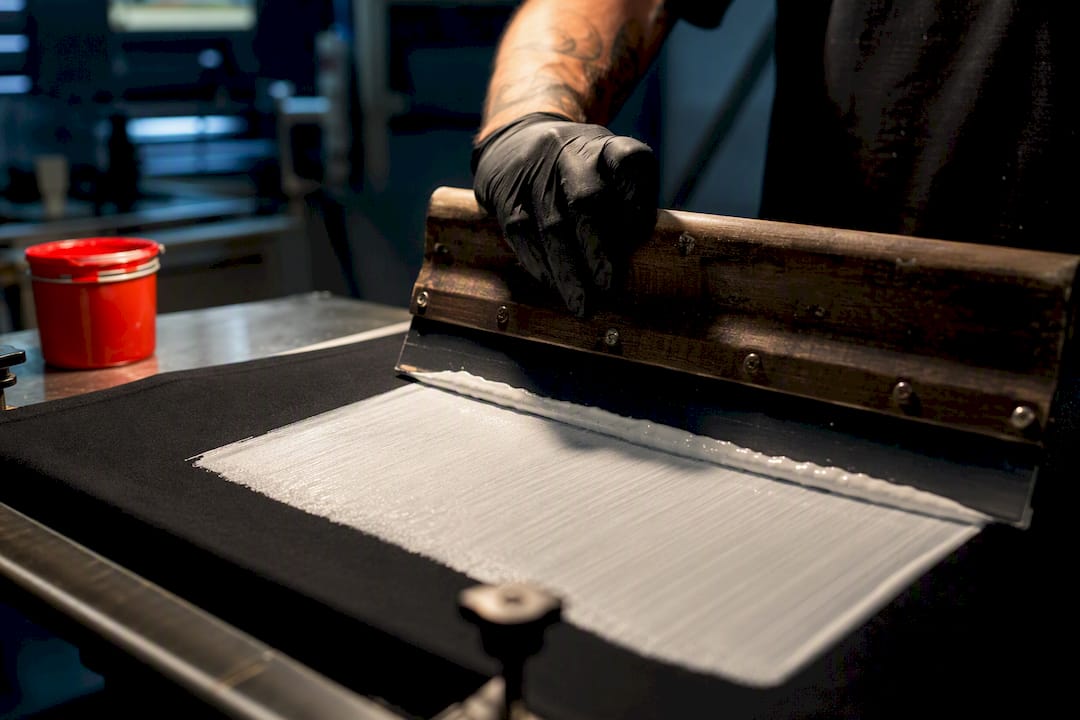
Screen printing remains the standard for high-volume dark-shirt jobs because it can deposit enough opaque white ink to fully block the garment color underneath. Any fabric darker than medium gray needs that white layer, or your top colors shift toward gray and lose saturation. The underbase acts like a mini projector screen: it reflects light back through the color layers so red reads as red instead of maroon.
Print shops measure underbase opacity by ink deposit, generally expressed in grams per square meter. A thin, single pass of white rarely blocks a black or navy shirt completely, so most professional setups use a relatively coarse mesh to lay down a heavier deposit, then switch to a finer mesh for the topcoat colors where detail matters more than coverage.
The production sequence looks like this:
- Print the white underbase first, using a high-opacity plastisol formulated for dark garments.
- Flash the underbase to a gel state, not a full cure, so the topcoat inks can bond to it.
- Print the color layers on top, then run the finished shirt through a conveyor dryer for full cure.
- Verify the cure with a stretch test or wash sample before shipping the batch.
Getting the temperatures right separates a clean job from a smeared one. Flash units typically bring the underbase to a surface temperature of about 240 to 260 degrees Fahrenheit to reach gel stage, while full cure for plastisol is done at a temperature that ensures complete ink bonding, often specified by ink manufacturers Rush the gel stage and the topcoat will pick up wet ink from the underbase instead of printing cleanly on top of it.
Pro Tip: If a design has fine text or thin lines over a dark shirt, ask your printer whether they’re using a “choke” on the underbase. Choking the white slightly smaller than the top color hides small registration shifts and keeps white haloing from showing around letters.
Screen printing is the right call when you need consistent color across dozens or hundreds of shirts and durability matters more than a soft hand feel. Its main failure mode is under-cured ink, which cracks and flakes after a handful of washes, and shops that skip proper opacity testing on new dark fabric batches, as Inkoo points out, run into faded or shifted color within weeks of a customer wearing the shirt. For bulk orders specifically, checking current pricing across volume tiers helps set expectations before you commit to a screen print run.
DTF transfers: why they work well on dark shirts and what to expect
DTF, or direct-to-film printing, solves the dark-shirt problem differently than screen printing does. Instead of laying a separate white underbase directly on the garment, the printer deposits a white layer onto the film itself, underneath the color, then presses the whole transfer onto the shirt as one unit. The opacity is baked into the film before it ever touches the fabric, which makes color consistency far more predictable than the multi-pass underbase work screen printing requires.
That built-in white layer is also why DTF handles complex, full-color, photo-style artwork on dark garments better than most other methods in this price range. Gradients, small text, and fine detail transfer cleanly because the film was printed at full resolution before pressing, not built up pass by pass on a screen.
A few practical points worth knowing before you order:
- Hand feel: Sits between screen printing and DTG. Thinner than a heavy plastisol underbase but with a slight surface texture you can feel.
- Finishing style matters: Hot-peel films release the carrier sheet immediately after pressing, while cold-peel films need to cool first. Cold-peel generally holds up to more wash cycles.
- Adhesive and film quality vary by supplier. Cheap film stock can crack at fold lines faster than premium film, even with identical artwork.
- Substrate flexibility: DTF works across cotton, polyester, blends, and even nylon, which makes it a good fit for mixed-fabric orders where screen printing would need different ink chemistry per garment.
DTF earns its spot when you’re running small-to-medium batches (think 5 to 100 pieces), mixing fabric types in one order, or working with artwork too detailed for practical screen setup. It’s also the practical answer for shops or individuals without the mesh, flash unit, and cure oven that plastisol screen printing demands. A closer look at full-color DTF production and design prep covers the file-prep side in more detail, and if you’re weighing DTF against traditional screens for a specific project, comparing DTF and screen printing directly is worth the five minutes it takes to read.
DTG on dark shirts: capabilities, pre-treatment, and reliability limits
DTG can produce sharp, photo-realistic prints on dark shirts, but only with equipment built specifically for it. A standard DTG printer without a white-ink channel simply cannot print on dark fabric at all, since the CMYK inks alone are as transparent as watercolor on black cloth.
Machines equipped for dark garments lay down a white base layer first, then print color on top, similar in concept to the screen-printing underbase but applied through inkjet heads instead of a mesh screen. That white layer has to bond to a pretreatment solution sprayed onto the shirt beforehand, and the pretreatment step is where most DTG problems start.
- Pretreatment inconsistency is the single biggest cause of DTG failures on dark garments. Too little, and the white ink sits on top of the fibers instead of bonding, leading to cracking. Too much, and the shirt develops a stiff, plastic-feeling patch where the design sits.
- Humidity affects drying time for both the pretreatment and the white ink layer, which means shops in variable climates need tighter process controls than a shop running climate-controlled equipment year-round.
- Polyester is a poor match for most DTG pretreatment chemistry, since the solution is formulated for cotton fibers. This is why DTG on dark shirts works best on 100% cotton and struggles on athletic or poly-blend garments.
- White-ink cracking or wash-off shows up when cure temperatures run too low or when the printer skips a proper drying cycle between the white layer and the color pass.
DTG is worth choosing for a single detailed, photo-quality print on a cotton shirt, especially portrait-style or gradient-heavy artwork where screen printing would need a dozen separate screens to match the color range. It’s a poor fit for large orders, since print speed per shirt is slower and per-unit cost climbs compared to screen printing or DTF once you’re past a few dozen pieces. Readers curious about photo-style artwork specifically should look at how file prep for photographic printing differs from standard graphic designs.
Discharge printing: soft-hand option for 100% cotton dark shirts
Discharge printing takes a completely different approach than every method above. Instead of adding an opaque white layer on top of the fabric, discharge ink chemically removes the garment’s existing dye and deposits pigment in its place. The result sits nearly flush with the fabric surface, with almost none of the raised, plasticky feel that underbase-heavy screen prints leave behind.
That soft hand comes with a strict trade-off: discharge only works on reactive-dyed 100% cotton. Polyester and most blends don’t discharge the same way, since the dye chemistry that makes the ink activate simply isn’t present in synthetic fibers. Try discharge on a poly-cotton blend and you’ll get a faded, patchy result instead of a clean pigment print. As Kornit notes, discharge is fundamentally a cotton-specific technique.
- Chemical handling matters. Discharge agents involve controlled chemistry that requires proper ventilation and shop safety procedures, which is part of why not every print shop offers it.
- Durability holds up well on compatible cotton, since the pigment becomes part of the fiber rather than sitting on top of it.
- Aesthetic fit: Discharge is the go-to for vintage-look band merch, retail graphic tees, and any design where a worn-in, soft feel matters more than punchy, saturated color.
If your project calls for cotton specifically, it’s worth understanding what makes different cotton sources behave differently under dye and print chemistry. Turkish cotton’s fiber characteristics illustrate how much fabric sourcing affects hand feel and dye uptake, which matters just as much for discharge results as thread count does.
Heat transfers and vinyl: maker and small-batch options
For single shirts, gifts, or hobby-scale batches, heat transfer vinyl (HTV) and white-toner transfers get the job done without any industrial equipment. HTV is cut on a vinyl cutter, weeded by hand, and pressed onto the shirt with heat and pressure. White-toner transfers work through a specialty printer and toner that includes a white layer, similar in concept to DTF but printed and cut at a smaller scale.
- HTV gives crisp edges for text and simple logos but adds a noticeably thicker, more rubbery feel than DTF or screen printing.
- White-toner transfers handle full-color designs on dark shirts reasonably well for one-off orders, though the print sits higher on the fabric than a professional DTF transfer.
- EasySubli-style sublimation HTV lets you sublimate a design onto a white or light-colored film, then heat-press that film onto a dark shirt, working around sublimation’s normal limits on dark fabric.
- Tooling needs are minimal: a cutter, a weeding tool, and a heat press cover most of these methods, which is why they’re popular with hobbyists and small Etsy-style shops.
These methods make sense for a handful of shirts or highly customized, small-run orders where setting up a screen or ordering a DTF sheet doesn’t make financial sense. A practical guide to single-shirt printing options walks through the tooling side in more depth if you’re deciding whether to DIY or order out.
Sublimation on dark shirts: why it generally fails and what workarounds exist
Sublimation ink is transparent by design. It’s built to dye light-colored polyester from the inside out, not to sit as an opaque layer on top of dark fabric, which means printing directly onto a black or navy cotton shirt produces almost no visible result at all. According to sublimation-specific guides, the only paths around this involve adding a white receptive layer, whether that’s sublimation HTV, a coating spray, or in rare DIY cases, bleaching the fabric first. Every one of those workarounds sacrifices something, whether it’s a thicker hand feel, weaker wash durability, or an uneven finish. Sublimation still shines on light polyester, all-over prints, and hard-surface blanks like mugs. Dark cotton shirts just aren’t its lane.
Fabric compatibility, dye migration, and curing controls that prevent failures
Most dark-shirt print failures trace back to two things: moisture and heat management. Both are fixable with process discipline, not expensive new equipment.
Pre-pressing a garment for 3 to 5 seconds before applying any heat transfer removes trapped moisture in the fibers. Skip that step, and the moisture turns to steam under the heat press, which is exactly what causes bubbling and hazy, uneven patches in the finished print. It’s a small step that takes seconds and prevents one of the most common complaints shops hear from customers.
Polyester garments introduce a second risk: dye migration. The dark dye in polyester fibers can bleed upward into a white ink layer when heat is applied, turning crisp white into a dingy gray or pink tint over time. Shops that print regularly on dark polyester use low-bleed white formulas and low-cure-temperature inks specifically designed to block that migration.
A short testing routine catches most problems before a full batch runs:
- Run a test print on the actual fabric and color you’re ordering, not a similar substitute.
- Wash-test the sample at least twice before approving a full production run.
- Check registration and edge alignment on the sample, since misalignment usually repeats across an entire batch.
- Confirm cure temperature with a probe or the gel-stage guidance your printer follows, rather than trusting a visual check alone.
Pro Tip: Ask any shop quoting a large dark-shirt order for a wash sample before you commit to full production. A shop confident in its process will hand one over without hesitation.
Decision checklist and questions to ask before ordering
Match the method to the job using these five factors before you request a quote:
- Fabric type. Cotton opens up every method including discharge; polyester and blends narrow you to DTF, screen printing with low-bleed whites, or HTV.
- Order size. One to a few dozen pieces favors DTF, DTG, or HTV; 50-plus pieces usually makes screen printing the better economic choice.
- Desired hand feel. Discharge for the softest result, DTF or DTG for a moderate feel, plastisol screen printing for the thickest and most durable.
- Design complexity. Photo-realistic or gradient-heavy art favors DTG or DTF; simple logos and text work fine with screen printing or HTV.
- Budget and turnaround. Bulk screen printing wins on per-unit cost at scale; DTF and DTG carry higher per-piece costs but no setup fees for small runs.
Before placing an order, ask the printer directly about their underbase specs, whether they run a wash test on new fabric colors, and what their sample policy looks like. A shop that hesitates to answer, or that offers full-color art on dark cotton with no mention of an underbase at all, is a red flag worth walking away from. Reviewing what to check before ordering custom apparel covers a few more vendor red flags worth knowing.
How Toronto Custom T-Shirts handles dark-shirt jobs
Torontocustomtshirts runs DTF transfers, screen printing with a proper white underbase, and discharge printing where the fabric supports it, alongside print-ready artwork support for customers who need help prepping files. Orders range from a single shirt to full bulk runs, with local pickup available in Mississauga.
Every dark-garment job goes through the same production checks covered above: pre-pressing to clear moisture, underbase opacity verified before full runs, test prints for new colorways, and cure verification before a batch ships. Case studies and customer feedback specific to dark-shirt runs are being compiled as an ongoing resource for readers comparing options.
Cost comparison of different printing methods specifically for dark shirts
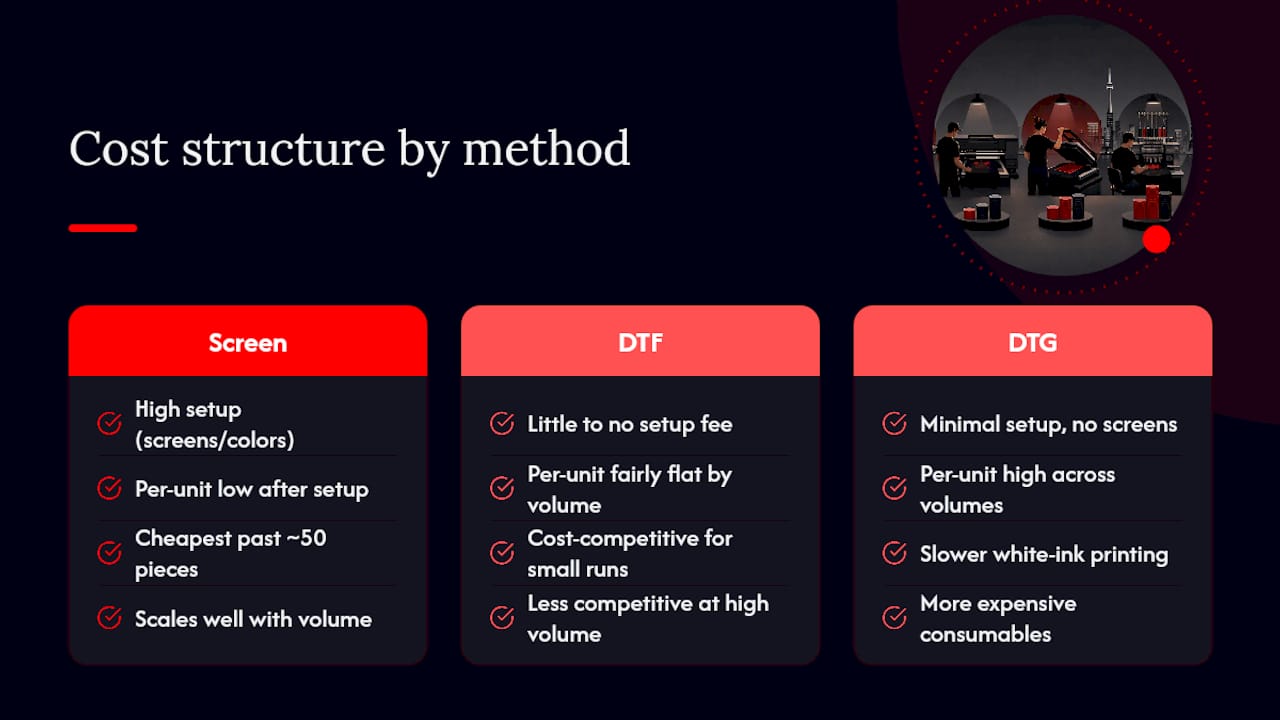
Cost on dark shirts breaks down differently than it does on light-colored garments, because the white underbase or film adds a real cost most people don’t budget for upfront. Screen printing carries setup costs tied to the number of screens and colors in a design, but once that setup is paid for, per-unit cost drops fast, which is why it stays the cheapest option for orders past roughly 50 pieces.
DTF flips that structure. There’s little to no setup fee, since there’s no screen to burn, but the per-unit cost stays fairly flat whether you order 5 shirts or 50. That makes DTF cost-competitive for small runs and less competitive once volume climbs high enough for screen printing’s setup cost to amortize away. DTG sits at the higher end of per-unit cost across the board, since white-ink printing runs slower and uses more expensive consumables than plastisol or film transfers.
Discharge printing’s cost depends heavily on shop capability, since not every printer runs the chemistry needed for it, and the specialized process can carry a premium over standard plastisol screen printing even though the finished feel is lighter. Heat transfer vinyl and white-toner transfers land in the middle for one-off pricing but scale poorly, since labor time per shirt doesn’t drop the way it does with screen printing or gang-sheet DTF runs. For a specific volume breakdown, current bulk pricing tiers give a clearer picture than any general rule of thumb can.
Environmental impact and sustainability considerations of each method
Plastisol screen printing relies on PVC-based inks that don’t biodegrade easily, and the curing ovens run on continuous heat, which adds up in energy use across a large production run. Water-based and discharge inks generally carry a lighter environmental footprint than plastisol, since discharge chemistry works with the fabric’s existing dye rather than layering synthetic ink on top of it, though the chemical agents used still require careful handling and disposal.
DTF and DTG both avoid the water-intensive rinse cycles that some older printing chemistries required, but DTF introduces a plastic film layer and adhesive powder into the waste stream that screen printing doesn’t generate. DTG’s water-based inks tend to be less resource-intensive than plastisol, though the pretreatment solution itself involves chemical inputs.
Order size affects sustainability just as much as method choice does. A method with a heavier environmental footprint per unit can still be the more sustainable overall choice if it means one bulk run instead of several smaller reorders shipped separately over time. For shops and individuals trying to minimize impact, asking a printer about ink type, water usage, and waste handling matters more than picking a single “green” method, since practices vary widely between shops even using identical equipment.
Publisher perspective: when softness matters more than brightness
The trade-off nobody explains clearly enough: brightness and softness pull in opposite directions on dark shirts, and the “best” method depends entirely on which one your project actually needs. A retail brand chasing vibrant, poster-bright graphics should lean toward screen printing or DTF, since both deliver an opaque, saturated result. A band selling vintage-style merch, on the other hand, is usually better served by discharge, even though the color range is more limited, because the soft, broken-in feel is the whole point of that aesthetic. Team shirts and one-off gifts tend to favor DTF for the simple reason that most buyers want good color and reasonable durability without paying for screens they’ll never reuse. Ignore the fabric and the goal, and you’ll end up with a technically correct print that still feels wrong in someone’s hands.
— Toronto
Get a dark-shirt print quote and sample before you commit
Torontocustomtshirts gives you a faster, lower-risk path than juggling multiple vendors for different methods: one shop that runs DTF, screen printing with proper underbase work, and discharge where the fabric allows it, all under one roof with print-ready artwork support included.
Whether you need a single shirt for a gift or a few hundred for a team launch, the process starts the same way: send your artwork, confirm fabric and quantity, and get a proof before anything goes to press. Local pickup is available in Mississauga, and shipping covers the rest of the GTA and beyond. If you’re planning a larger run, bulk order pricing with volume discounts is worth checking before you finalize quantities. For everyone else, starting a custom order in Toronto gets you a live design preview and a quote without any commitment upfront.
Sources
- 7 Types of Shirt Printing and Their Benefits | Kornit
- Textile printing on dark clothing: what pitfalls should you avoid? | INKOO
- Sublimation On Dark Shirts: Honest Guide (With 2 Tutorials)
- Pre-pressing garments for heat printing | Transfer Express blog
- How to screen print on dark-colored shirts — Printable Press
Recommended
Get pricing in 24h.
Toronto-based, no minimums. Tell us about your project and we'll email a detailed quote within one business day.
Request a Quote