$3–$75 Per Unit: 2026 Merchandise Pricing for Marketers in Canada
2026 per-unit ranges ($3–$75), worked budget examples, and an itemized quote checklist marketers in Canada use to convert vendor quotes into all in...
$3–$75 Per Unit: 2026 Merchandise Pricing for Marketers in Canada
Expect roughly $3 to $75+ per unit depending on category, decoration method, and quantity, with the widest swings coming from three factors: blank quality, decoration technique, and order volume. Before you approve any quote, ask for an itemized breakdown separating the blank cost, decoration charge, and setup fee, plus a physical sample. That single request catches most of the hidden costs that turn a “reasonable” number into a budget-buster.
TL;DR:
- Volume discounts can significantly lower per-unit costs, with drops of 10 to 40 percent between specific order size tiers due to setup and operational efficiencies.
- Custom apparel costs range from $5 to $12 at the budget level, $15 to $30 mid-tier, and over $35 for high-end options like fleece jackets or performance wear.
- Decoration methods like screen printing are cheapest for large, simple designs, while full-color or detailed logos often favor DTF and DTG transfer techniques to avoid high setup fees.
- Asking vendors for separate quotes on setup, blank, and decoration costs is crucial for accurate budgeting and effective negotiation.
- Ordering during vendor slow seasons or combining multiple product categories into a single shipment can reduce overall costs and improve turnaround times.
Table of Contents
- Average Cost of Branded Merchandise by Category
- What Drives the Price of Custom Branded Merchandise
- How to Budget and Forecast Total Program Cost
- How to Reduce Costs and Negotiate Better Vendor Terms
- How Toronto Custom T-Shirts Approaches Pricing, Samples, and Rush Jobs
- Factors Affecting Pricing Decisions
- Pricing Strategies for Brand Merchandise
- Impact of Customization Options on Pricing
- Seasonal or Promotional Pricing Tactics
- Legal Considerations Affecting Pricing
- Editorial Take: What Actually Matters in a 2026 Merchandise Budget
- How Toronto Custom T-Shirts Can Execute Your Program
- Sources
- FAQ
Average Cost of Branded Merchandise by Category
Brand merchandise pricing splits into three rough tiers across every product type, and the gap between them is bigger than most first-time buyers expect. A basic cotton tee and a heavyweight fleece hoodie with a tackle-twill logo aren’t in the same conversation, even though both count as “apparel.”
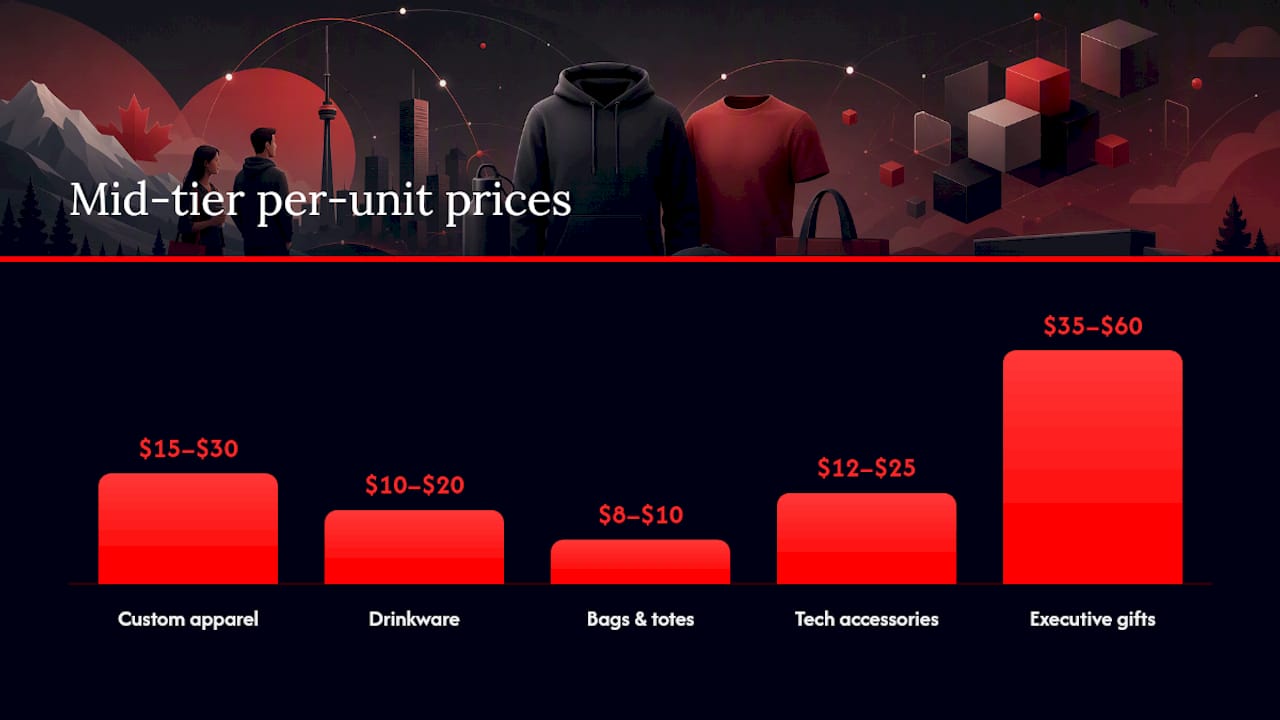
Custom apparel runs from about $5 to $12 per unit at the budget end, $15 to $30 in the mid-tier, and $35 to $75 or more for premium pieces like fleece-lined jackets or performance wear, according to Imprint Engine’s 2026 pricing breakdown. Drinkware follows a similar curve: budget tumblers land around $3 to $8, mid-tier insulated bottles run $10 to $20, and premium vacuum-sealed bottles with laser engraving can clear $25 to $45. Bags and totes range from $2 to $6 for a basic non-woven tote up to $25 to $60 for a leather-accented duffel or backpack.
A separate quarterly benchmark backs this up at the practical level: the Bulk Merch Price Index for Q3 2026 puts delivered custom t-shirts at roughly $7 to $10 per unit at a 100-piece order, and hoodies at $22 to $28 for the same quantity. That’s a useful sanity check when a vendor quote comes in wildly outside those bands in either direction.
| Category | Budget tier | Mid-tier | Premium tier |
|---|---|---|---|
| Custom apparel (tees, tanks) | $5–$12 | $15–$30 | $35–$75+ |
| Drinkware (bottles, tumblers) | $3–$8 | $10–$20 | $25–$45+ |
| Bags & totes | $2–$6 | $8–$10 | $25–$60+ |
| Tech accessories | $4–$6 | $12–$25 | $30–$60+ |
| Pens & office items | $1–$3 | $4–$6 | $12–$25 |
| Executive gifts | $15–$30 | $35–$60 | $75–$200+ |
Volume affects pricing significantly. Larger order quantities reduce per-unit costs as setup fees are spread over more items and operational efficiencies increase. This pattern applies to various product types with meaningful drops at volume breakpoints.
A few categories break the pattern and deserve a specific callout:
- Vacuum-insulated bottles often carry a $5 to $10 premium over standard tumblers because of the tooling required for laser engraving on curved steel.
- Power banks price closer to tech accessories than office swag, frequently landing in the $15 to $35 range even at 250+ units, since the internal components don’t get cheaper with scale the way printing does.
- Tackle-twill or embroidered patches on outerwear can add $3 to $8 per piece regardless of order size, because each patch is a separate manufacturing step.
What Drives the Price of Custom Branded Merchandise
Three factors do most of the work in any quote: the blank, the decoration method, and the quantity. Understanding how they interact is the difference between negotiating intelligently and just accepting whatever number a vendor sends over.
The blank itself, meaning the plain garment or product before any branding goes on, typically accounts for a large share of per-unit variation. Fabric weight (measured in GSM) and fiber blend can shift a shirt’s base cost by several dollars before a single logo gets printed, and substrate choice alone can account for roughly 40 to 55 percent of the price variation you see across categories.
Decoration method comes next. Screen printing tends to be the most economical option for large runs of simple, one or two-color designs, but it carries a real setup cost per screen. DTF and DTG transfer methods skip that setup and work well for smaller runs or full-color art, which is our own comparison of DTF versus screen printing covers in more depth. Embroidery, pad printing, and laser engraving each have their own cost curve, generally driven by how much time the piece spends in the machine rather than the ink itself.
Setup fees typically run $20 to $75 per color or per design, and that fee gets divided across your total order. That’s why volume tiers commonly produce a 10 to 40 percent per-unit price drop between breakpoints. Order 50 pieces and you’re paying most of that setup fee yourself; order 500 and it barely registers.
A few costs hide outside the per-unit number entirely:
- Kitting fees for assembling multi-item gift boxes or welcome kits
- Storage charges if a vendor holds inventory for staggered shipments
- Multi-address shipping surcharges for distributed teams
- Overrun or underrun allowances, since most print runs come in a few percent over or under the ordered quantity
Pro Tip: Ask every vendor for the setup fee and per-unit price as two separate line items, not one blended number. That’s the only way to calculate your real breakeven point if quantity changes mid-negotiation.
How to Budget and Forecast Total Program Cost
Every merchandise budget, whether it’s a trade show giveaway or a 1,000-person onboarding kit, boils down to one formula. SupplyBatch’s landed-cost model frames it this way:
Total cost = Σ[(unit cost × quantity) + setup cost per category] + freight allocation + compliance testing + duties
Here’s how that plays out in practice:
- Small test run (50 tees, one design): Unit cost $12 × 50 = $600. Setup fee $40. Freight $30. Total: $670, or $13.40 per unit once setup is folded in.
- 100-person team kit (tee, cap, tote): Tees at $10 × 100 = $1,000; caps at $14 × 100 = $1,400; totes at $6 × 100 = $600. Combined setup across three categories: $150. Freight and kitting: $200. Total: $3,350, or $33.50 per person.
- 1,000-employee annual program (hoodie plus accessory): Hoodies at $24 × 1,000 = $24,000; accessory (drinkware) at $12 × 1,000 = $12,000. Setup: $150. Freight allocation at scale: $800. Compliance testing for a new product line: $500. Total: $37,450, or $37.45 per employee.
Notice how per-employee cost drops even as total spend climbs, because setup and freight get diluted across more units. That’s the entire logic behind volume-tier pricing.
| Program size | Total cost | Cost per unit/person |
|---|---|---|
| 50-unit test run | $670 | $13.40 |
| 100-person team kit | $3,350 | $33.50 |
| 1,000-employee program | $37,450 | $37.45 |
Budgeting per person varies by program type. Lower-cost items like pens and basic totes are typical for giveaway programs, while premium executive gifts command higher budgets. It is also wise to allow for some overrun in quantities to avoid budget shortfalls.
How to Reduce Costs and Negotiate Better Vendor Terms
Consolidating shipments to a single hub instead of scattering orders across multiple vendors is one of the more reliable ways to cut freight, and it works especially well for multi-category programs where you’re ordering apparel, drinkware, and bags together. One shipment beats three.
Design simplicity saves money on the decoration side. Limiting your logo to one or two colors keeps screen printing setup costs low, and simplifying placement to a single chest print instead of chest-plus-sleeve-plus-back cuts labor time. If your design is genuinely full color or your run is under 100 pieces, DTF or DTG usually beats screen printing on total cost since there’s no per-color setup fee to amortize, a point our full-color DTF guide walks through in detail.
Timing matters more than most buyers realize. Reordering the same design within a set window often qualifies for a waived or reduced setup fee, since the vendor already has your artwork proofed and ready. Ordering during a supplier’s slower season can also unlock better turnaround without paying a rush premium.
Before signing off on any quote, demand answers to these questions:
- Is the setup fee itemized separately, or bundled into the per-unit price?
- What’s the actual minimum order quantity, and does it change the unit price?
- Are freight, kitting, and compliance testing included, or added after the fact?
- What’s the overrun/underrun policy if the final count doesn’t match exactly?
Pro Tip: If a vendor won’t break out setup, blank cost, and decoration into separate line items on request, treat that as a red flag. Transparent pricing is table stakes, not a favor.
How Toronto Custom T-Shirts Approaches Pricing, Samples, and Rush Jobs
Some vendors price with no minimum order quantity and offer a standard 48-hour turnaround, so a small test run isn’t penalized the way it is with vendors that enforce high MOQs. Quotes are built from your actual specs: artwork file, garment style, print locations, and quantity, all confirmed before production starts.
The most reliable way to validate any quote, from Torontocustomtshirts or elsewhere, is to request a physical sample and a written itemized breakdown before committing to a full run. That catches color mismatches and fit issues before they show up on 500 units instead of one.
Factors Affecting Pricing Decisions
Vendors don’t set prices in a vacuum. Market positioning plays a real role: a supplier chasing budget-conscious small businesses prices differently than one courting corporate accounts that expect premium finishing and dedicated account management. Neither approach is wrong, but they produce different quotes for what looks like the same shirt on paper.
Brand perception cuts both ways for the buyer. If your company markets itself as premium, cheap giveaway merchandise can actively undercut that positioning, so it’s worth paying up for a heavier blank or better print even when a cheaper option exists. Conversely, a startup handing out swag at a trade show doesn’t need executive-gift quality; matching merchandise tier to brand tier avoids both overspending and looking cheap.
Competitor pricing shapes vendor behavior more than buyers usually see. Suppliers in a crowded local market, like custom apparel printing in a major metro area, tend to compress margins on standard items (basic tees, simple one-color prints) while protecting margin on specialty work (embroidery, premium blanks, rush service). That’s why you’ll often see aggressive per-unit pricing on bulk tee orders but comparatively high prices on small specialty runs, since that’s where a vendor’s actual expertise and equipment investment show up.
Pricing Strategies for Brand Merchandise
Most merchandise vendors run on some blend of three pricing models, and knowing which one you’re dealing with changes how you negotiate.
Cost-plus pricing starts with the blank cost, decoration cost, and overhead, then adds a fixed margin. It’s the most transparent model and the easiest to reverse-engineer from an itemized quote, which is exactly why it’s worth asking vendors to break their pricing down this way.
Value-based pricing charges based on what the buyer is willing to pay rather than strict cost math. This shows up most in premium executive gifting, where a $150 gift box might cost the vendor $60 to produce but sells at a premium because the buyer values the presentation and brand impact more than the raw materials.
Competitive pricing means a vendor sets rates by watching what similar suppliers charge for comparable work, then positions slightly above or below that. This is common for high-volume commodity items like basic tees and tote bags, where differentiation is thin and buyers comparison shop aggressively.
For your own budgeting, cost-plus thinking is the most useful lens: build your total from blank plus decoration plus setup plus freight, then evaluate whether the vendor’s final number tracks reasonably with that math. If it doesn’t, ask why.
Impact of Customization Options on Pricing
Every customization decision adds a specific, quantifiable cost, and stacking too many of them is the fastest way to blow a budget without noticing.
Print location is the first lever. A single chest print costs less than chest-plus-back, and adding a sleeve print multiplies your decoration charge by roughly the number of locations, since most methods require separate setup or passes per placement. A back print typically runs around $5 and a sleeve print around $3 per piece on top of the base shirt cost, which gives you a concrete sense of how location stacking adds up on a real order.
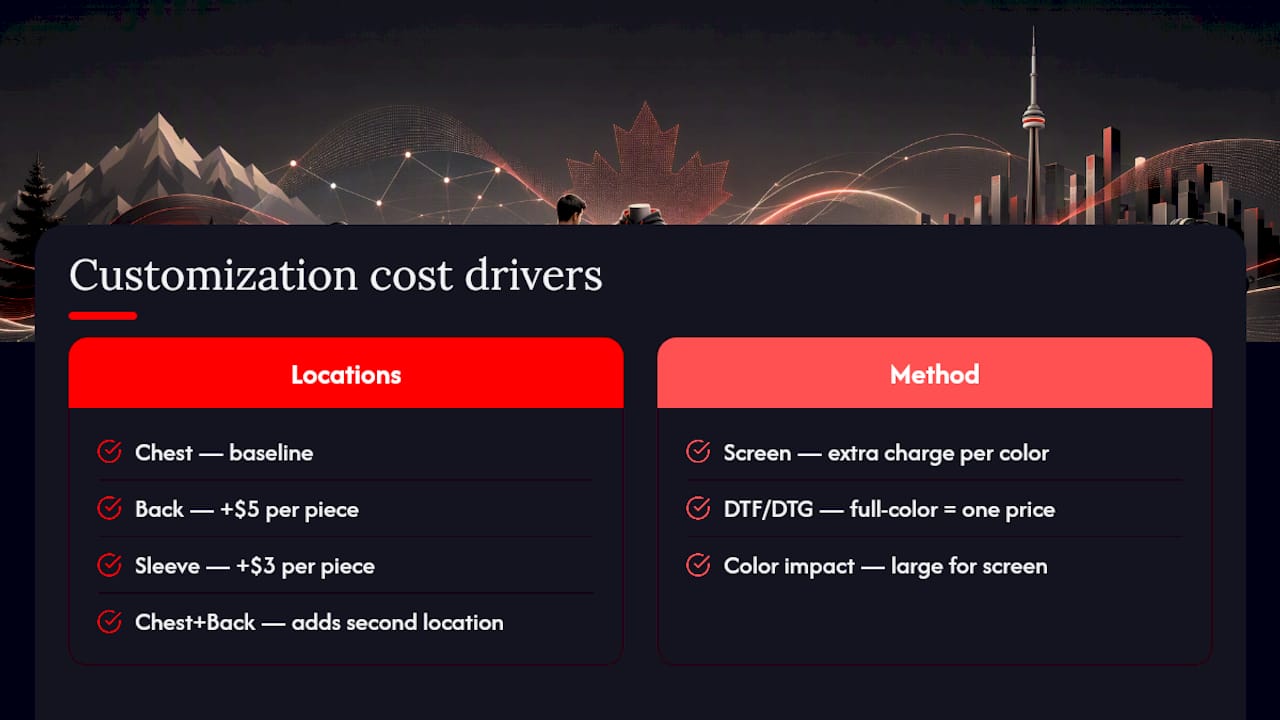
Color count matters most for screen printing specifically, since each additional color requires its own screen and setup charge. DTF and DTG sidestep this because full-color art costs the same as one-color art, which is a major reason those methods win out for detailed logos or photo-quality designs even on modest runs.
Specialty finishes, metallic ink, puff print, glitter, foil, typically add a per-unit surcharge on top of standard decoration pricing, and some require dedicated equipment that not every vendor stocks. Oversized prints (full-front graphics that exceed standard print area) also carry a premium, generally $3 to $5 per piece, because they use more substrate and more press time.
Seasonal or Promotional Pricing Tactics
Merchandise pricing isn’t static throughout the year, and timing your order around a vendor’s slow season can meaningfully lower your total spend.
Blank apparel suppliers often run promotional pricing in late winter and midsummer, the gaps between the fall back-to-school rush and the holiday gifting season. Ordering during those windows can shave real money off your blank cost before decoration even factors in. Vendors themselves also tend to offer reorder discounts and package deals in January and September, when businesses are refreshing team apparel or planning Q1 launches.
Holiday and trade show season (October through December) typically sees rush fees climb and turnaround times stretch, simply because demand spikes across every printer at once. If your event or campaign date has any flexibility, shifting your order even two to three weeks earlier than peak season avoids paying a premium for the same production slot everyone else wants. Locking in rush turnaround during a slower period, like the 1 to 12 week windows partner guides describe for event favors, costs noticeably less than requesting the same speed in December.
Bundling is another underused tactic. Vendors are often willing to shave the setup fee or offer a small per-unit discount when you commit to a full apparel-plus-accessory package rather than ordering each category separately and asking for quotes one at a time.
Legal Considerations Affecting Pricing
Trademark and licensing costs rarely show up in a standard merchandise quote, but they belong in your budget the moment your design involves anything beyond your own registered brand.
If you’re using your own trademarked logo, there’s typically no licensing fee involved, just the standard production cost. The picture changes if your merchandise features a licensed property, a sports team logo, a university mark, a celebrity likeness, or co-branded partner artwork. Licensing fees for those arrangements are negotiated separately from production and can range from a flat fee to a per-unit royalty, depending on the rights holder’s terms.
Compliance testing adds another cost layer for specific product categories. Children’s apparel, for instance, faces stricter safety testing requirements than adult merchandise in most markets, and that testing cost gets passed through to the buyer as a per-order or per-batch fee. Electronics accessories like power banks may also require safety certification before they can ship internationally, which is worth confirming before you commit to that category for a large program.
None of this replaces legal advice for your specific situation, but building a placeholder line item for licensing or compliance costs into your initial budget prevents an ugly surprise later if your design plans shift toward licensed content.
Editorial Take: What Actually Matters in a 2026 Merchandise Budget
Most merchandise pricing advice treats the per-unit number as the whole story. It isn’t. The gap between quoted price and final invoice almost always comes from setup fees, freight, and compliance costs that never made it into the headline figure, and that gap is where budgets actually break.
The conventional wisdom, get the lowest per-unit price, treats merchandise like a commodity purchase. It isn’t one. A $9 tee with a muddy print and a two-week delay costs your brand more than a $14 tee that arrives on time and looks sharp in photos. Price and value diverge constantly in this category, and buyers who chase the lowest number without checking blank quality usually pay for it in reorders.
If there’s one thing worth prioritizing above everything else in this article, it’s the itemized quote. Not the final number, the breakdown behind it. Once you can see blank cost, decoration cost, and setup cost as three separate lines, you can negotiate each one independently, compare vendors honestly, and catch the fee that would have blown your budget before it does.
— Toronto
How Toronto Custom T-Shirts Can Execute Your Program
Some suppliers skip the agency markup and the middleman entirely: you get instant online design, checkout, and pricing with no minimum order quantity, so a 12-piece test run and a 500-piece team kit both get the same direct, transparent process.
Getting a quote moving is simple. Have your vector artwork ready (or let us help clean up a rough file), know your target quantities and decoration locations, and confirm whether you need local pickup in Mississauga or shipping. For full-color designs or smaller runs, start with DTF gang sheet printing, priced from $0.40 per transfer depending on size, or build a full gang sheet from $40.80. For team apparel and bulk business orders, our bulk order services cover DTF-printed custom t-shirts from $15.00 to $24.90 per shirt, with back prints at $5, sleeve prints at $3, and oversized prints from $3 to $5.
Send us your specs and target delivery date, and we’ll turn around an itemized quote so you know exactly what you’re paying for before you commit to a single piece.
Sources
FAQ
Where can I find branded merchandise in Canada?
Local printers like Torontocustomtshirts serve Toronto, Mississauga, and the GTA with both custom design and bulk order options, while national suppliers and online promotional product catalogs cover broader Canadian markets.
What swag does Gen Z like?
Younger buyers tend to favor practical, everyday items over throwaway giveaways, think quality tote bags, tech accessories, and comfortable apparel over pens and stress balls, since those items actually get used and seen after the event ends.
How much does merchandise cost?
Per-unit prices typically range from $3 to $75 or more depending on category, decoration method, and order size, with custom apparel commonly falling between $5 and $30 per piece at standard volumes.
How much should I charge for merch design?
Design fees vary widely by complexity and aren’t standardized across the industry, but many vendors either bundle basic design help into a decoration setup fee or charge a separate flat fee for original artwork creation, so it’s worth asking upfront which applies to your order.
Recommended
Get pricing in 24h.
Toronto-based, no minimums. Tell us about your project and we'll email a detailed quote within one business day.
Request a Quote