Bulk Printing Cost Factors for Teams and Businesses
Discover key bulk printing cost factors that impact your apparel order. Learn how setup fees, printing methods, and more can save you money.
Bulk Printing Cost Factors for Teams and Businesses
Three numbers determine whether your bulk apparel order comes in on budget or blows up at checkout: your fixed setup cost, your per-unit variable cost, and your quantity. The bulk printing cost factors that matter most are setup fees (amortized across the run), printing method, blank garment cost, print coverage and color count, finishing choices, and shipping or rush charges. Get an itemized quote and request a proof or wash test before approving any order.
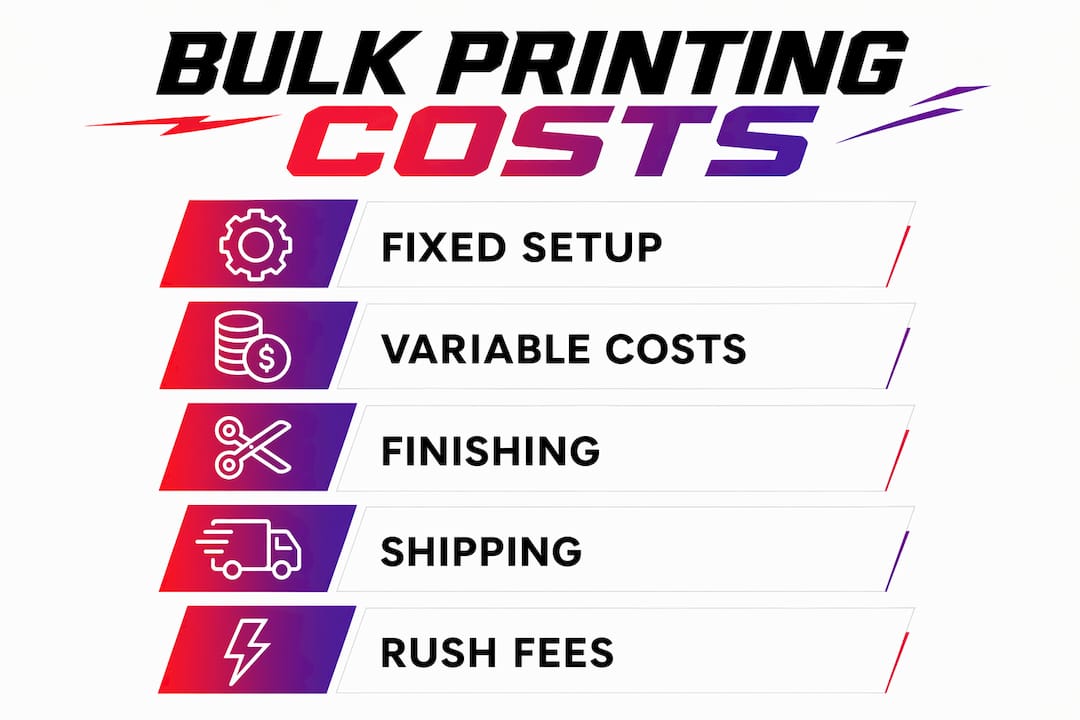
The primary cost drivers in bulk apparel printing:
- Setup fees: Screen printing plates, DTF film setup, or embroidery digitizing — fixed costs that shrink per unit as quantity rises
- Printing method: DTG/DTF suits short runs; screen printing wins at higher volumes
- Blank garment cost: Brand, fabric weight, and size distribution all move the number
- Print coverage and color count: Full-chest coverage costs more than a small chest logo; each additional screen color adds a setup charge
- Finishing: Woven labels, neck prints, hem tags, and custom packaging each add a per-unit fee
- Shipping and rush fees: Often excluded from teaser per-piece rates; advertised rates frequently exclude proofs, prepress, and freight
Pro Tip: Quantity is the single biggest lever. Fixed setup costs spread across more units, so the per-piece price drops sharply as volume rises — but only if your design and method stay consistent.
Table of Contents
- How to calculate per-unit cost for a bulk apparel order
- Which printing method fits your run size and budget?
- How setup fees and versioning multiply your total cost
- How garment blanks and finishing choices change your quote
- Turnaround, shipping, and the hidden fees that blow up a quote
- What to ask before you approve a bulk apparel quote
- Practical ways to lower bulk printing cost
- What a transparent bulk apparel quote actually looks like
- Key Takeaways
- What most buyers get wrong about bulk apparel pricing
- Torontocustomtshirts makes bulk apparel pricing straightforward
- Before you place a bulk apparel order, confirm these
How to calculate per-unit cost for a bulk apparel order
The formula is straightforward:
(Total fixed setup costs + Total variable costs + Other fees) ÷ Quantity = Per-unit cost
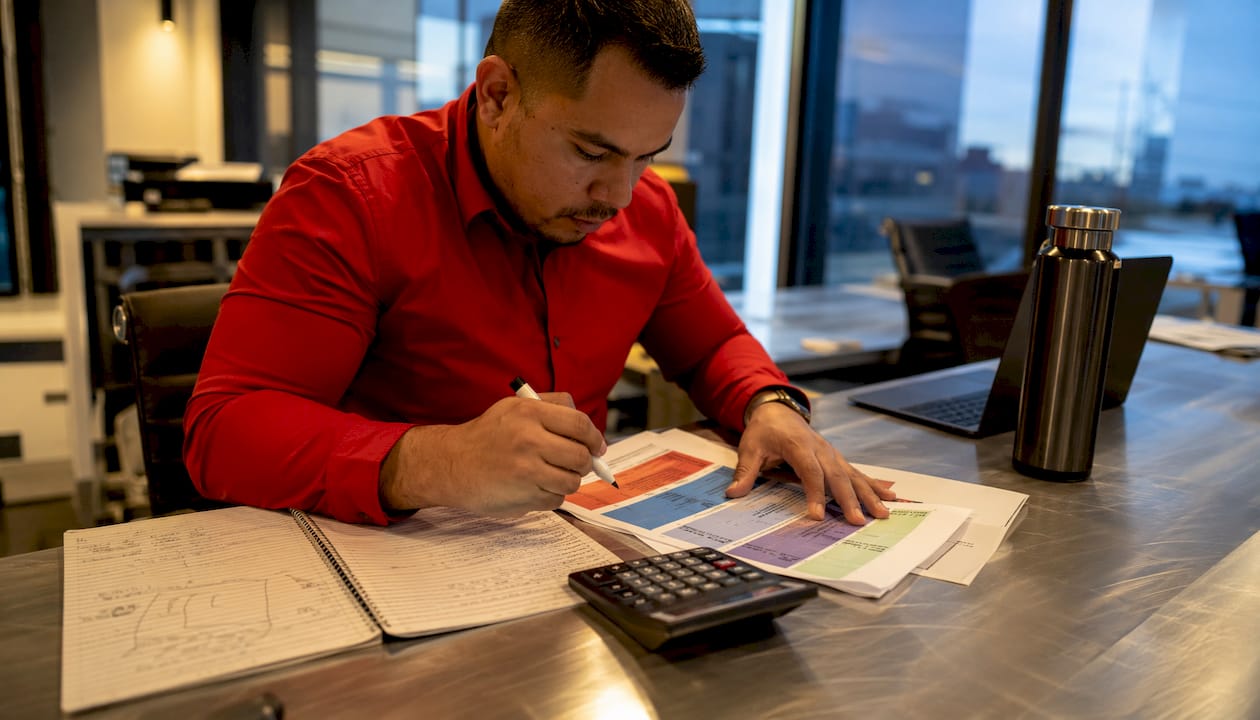
Fixed setup covers screens, plates, or digitizing files. Variable costs include the blank garment, ink or DTF film, finishing labor, and packing. Other fees are shipping, proofs, and prepress file prep.
Worked example — 1,000 vs. 5,000 t-shirts (screen printing, one color, front only):
| Cost component | 1,000 units | 5,000 units |
|---|---|---|
| Finishing + packing | $0.30 / $300 | — |
The setup fee is identical in both runs. At 5,000 units it contributes less than a cent per shirt. That’s setup cost amortization at work.
Common miscalculation pitfalls:
- Counting only print cost and ignoring the blank garment (often the largest single line item)
- Forgetting versioning: each colorway or design change requires a separate screen setup
- Leaving out finishing labor and packing, which can add $0.25–$0.50 per unit on folded/bagged orders
- Estimating shipping as a flat dollar amount rather than calculating by weight and destination ZIP
Which printing method fits your run size and budget?
The right printing method depends on your quantity, design complexity, and how much per-unit cost you can absorb at setup.
| Method | Best for | Typical setup | Per unit at 25 / 100 / 500 | Color limits / adders | Turnaround |
|---|---|---|---|---|---|
| DTG / DTF | 1–150 units, full-color photos | Low / none | — | Unlimited colors; underbase adds cost on darks | 2–5 days |
| Screen printing | 50+ units, simple designs | $25–50 per color | — | Each spot color = new screen; metallic/specialty inks extra | about a week to two weeks |
| Embroidery | Logos, hats, polos | digitizing fees apply | variable per-unit cost depending on complexity | Stitch count drives cost; photo-realistic art not viable | typical turnaround about a week to two weeks |
| Heat transfer / vinyl | Small runs, names/numbers | Low | — | Multi-color adds layers; not ideal for large coverage | 2–5 days |
Screen printing becomes cost-efficient once a run climbs past roughly fifty pieces for a single-color design. Below that threshold, DTF or DTG usually wins on total cost. Full-front coverage costs meaningfully more than a small chest logo regardless of method, because ink volume and film area both scale with coverage.
Dark garments add an underbase layer in screen printing and DTG, which counts as an extra color and an extra pass. Budget for it.
How setup fees and versioning multiply your total cost
Setup fees are fixed per design, per color, per version. A single-color front print at 500 units carries one screen charge. Add a back print, a sleeve hit, and a second colorway, and you’re paying for four separate setups before a single shirt is printed.
Calculating true cost when multiple versions exist:
- List every distinct design, placement, and colorway as a separate version
- Assign a setup fee to each version
- Multiply per-unit variable cost by the quantity for that version
- Sum all version totals plus a single shipping estimate
Gang-run printing solves part of this problem. Printers combine multiple small orders onto one press sheet or run, sharing the fixed setup cost across customers. For apparel, gang-run works best when artwork areas are small, blanks are a common size, and ink types are compatible. It’s how smaller buyers access commercial per-unit pricing without committing to 500+ units of one design.
Pro Tip: Ask your printer whether they offer gang-run windows, what the minimum quantity is to join a shared run, and how they handle overs and unders — some runs produce 2–5% more or fewer pieces than ordered.
How garment blanks and finishing choices change your quote
The blank garment is often the largest single cost line in a bulk apparel order, yet buyers frequently underestimate it.
Economy blanks (thin, 100% polyester or lightweight cotton) run roughly $2.50–$4.00 each. Midweight cotton tees land around $4.00–$6.50. Premium ring-spun or tri-blend styles push $7.00–$12.00 or higher. Heavier garments like crewneck sweatshirts sit at $12.00–$22.00 depending on weight and brand.
Size distribution matters more than most buyers realize. An order of 200 shirts split evenly across S–2XL will cost more in blanks than the same 200 shirts split across S–L, because XL and 2XL blanks carry a size surcharge of $1.00–$3.00 per unit at most suppliers. Model your actual size split before accepting a quote based on a “medium” price.
| Finishing add-on | Typical per-unit cost |
|---|---|
| Inside neck print | $0.75–$1.50 |
| Woven label (sewn) | $1.00–$2.50 |
| Hem label | $0.75–$1.50 |
Packaging and label choices add up fast on large orders. A 500-unit run with individual poly-bags and inside neck prints can add $600–$1,000 to the total before a single shirt ships.
Turnaround, shipping, and the hidden fees that blow up a quote
Teaser per-piece rates almost never include everything. Before approving, add these line items to your estimate:
| Hidden or under-quoted fee | Typical range |
|---|---|
| Prepress / file prep | $25–$100 per job |
| Wash test sample | $20–$60 |
| Rush production premium | can significantly increase base cost depending on urgency and vendor |
| Overrun / underrun adjustment | ±2–5% of order qty |
Rush fees deserve special attention. A standard 7–10 business day production window is the baseline for most screen printing shops. Cutting that to 3–4 days can add 25–50% to the print cost alone. Plan your event or distribution date and work backward, adding transit time to the production estimate.
Estimate shipping as a per-piece dollar amount: take the total shipment weight (garment weight × quantity, plus packaging), apply a carrier rate for your destination ZIP, and divide by pieces. For a medium-sized t-shirt order shipping regionally, shipping costs often range modestly per shirt depending on distance and weight.
What to ask before you approve a bulk apparel quote
A reliable printer gives you a fully itemized quote without being asked. If they don’t, ask for it explicitly.
Must-ask checklist:
- Full line-item breakdown: setup, print, blanks, finishing, packing, and shipping to your ZIP
- Proof type: digital mockup or physical wash-test sample, and who pays for it
- Production turnaround and rush fee schedule
- Minimum order quantity and reorder pricing
- Color-match policy: PMS matching, print profile, or best-effort digital match
- Reprint and refund terms for color or print defects
- Overrun/underrun policy (how many pieces above or below the ordered quantity are acceptable)
- Reorder pricing: does your setup fee carry over, or do you pay it again?
Pro Tip: Ask for a “cart preview” or conditional quote that shows the final total with common adders already included: proof fee, expedited production, and estimated freight. Teaser rates that exclude these can look 20–40% cheaper than the actual invoice.
Trust signals worth noting: a printer who shares wash-test sample photos, states turnaround times in writing, documents minimums clearly, and publishes a reorder discount structure is showing you they’ve done this before and expect to do it again.
Practical ways to lower bulk printing cost
Tactical levers that actually move the number:
- Batch orders across teams or departments to hit a higher quantity tier and lower per-unit cost
- Choose house stock blanks over premium brands when the garment is for an event or uniform, not retail
- Simplify color count — dropping from three spot colors to two eliminates one screen setup
- Minimize print coverage — a 3-inch chest logo costs far less to print than a full-front design
- Consolidate versions — one design in two colors is cheaper than two designs in one color each
- Optimize your size split — fewer 2XL and 3XL units reduces blank cost on large orders
When to use print-on-demand (POD) vs. bulk:
| Scenario | Recommended approach |
|---|---|
| Testing a new design or merch concept | POD to validate demand first |
| Small run, high personalization (names/numbers) | DTF or DTG short run |
| Event promo, static design, 100+ units | Gang-run or bulk screen printing |
| Evergreen retail item, repeat reorders | Full bulk screen or embroidery |
| Corporate uniform, consistent logo | Bulk embroidery or screen |
Use POD to validate demand before committing to inventory. Once a design proves itself, switching to bulk screen printing typically cuts per-unit cost by 40–60% compared to POD rates at the same quantity.
Savings can backfire. Over-ordering to hit a price tier, then storing 300 extra shirts for six months, erases the per-unit savings through storage, repacking, and the risk of design changes making inventory obsolete.
What a transparent bulk apparel quote actually looks like
A well-structured quote separates fixed from variable costs so you can see exactly how price changes with quantity.
| Cost line | Fixed or variable | — | 1,000 units | 5,000 units |
|---|---|---|---|---|
| Screen setup (2 colors) | Fixed | $70 | $70 | $70 |
| Blank garment (midweight tee) | Variable | $1,375 | $4,800 | $21,000 |
| Print cost | Variable | $525 | $1,400 | $4,500 |
| Finishing (neck print + bag) | Variable | $250 | $875 | $3,750 |
| Shipping estimate | Variable | $95 | $280 | $975 |
| Total | $2,315 | $7,425 | $30,295 | |
| Per-unit cost | $9.26 | $7.43 | $6.06 |
The setup fee is the same at every quantity. Everything else scales. That’s the structure a transparent quote should show you.
A reputable printer provides a digital proof for approval before production begins, offers a physical wash-test sample on request, states turnaround in business days (not calendar days), and documents reorder pricing so your second run costs less than the first. Torontocustomtshirts structures quotes this way — itemized, with local pickup available in Mississauga to eliminate inbound freight for GTA buyers.
Key Takeaways
The single most important rule in bulk apparel pricing: never evaluate a quote on per-piece rate alone without seeing every line item, because setup, finishing, and shipping routinely add 25–40% to the base print cost.
| Point | Details |
|---|---|
| Setup amortization drives savings | Fixed setup fees stay constant; spreading them over more units is the primary source of bulk savings. |
| Method determines breakeven | DTF/DTG wins under ~50 units; screen printing becomes cheaper as runs climb past that threshold. |
| Blank and size split matter | Garment brand, weight, and size distribution can shift total blank cost by hundreds of dollars on a 500-unit order. |
| Hidden fees are predictable | Prepress, proofs, rush premiums, and freight are standard line items — request them upfront in an itemized cart. |
| Torontocustomtshirts | Offers itemized quotes, DTF and screen printing, local pickup in Mississauga, and reorder pricing for GTA buyers. |
What most buyers get wrong about bulk apparel pricing
The conventional wisdom is that bulk printing is simple: order more, pay less. That’s true at the headline level and misleading in practice.
The real trap is version creep. A corporate order that starts as “200 shirts, one design” quietly becomes 200 shirts across four departments, three colorways, two placements, and a youth size run. Each change adds a setup fee. By the time the order ships, the per-unit cost is closer to a short-run price than a bulk price, because the effective quantity per setup never got large enough to amortize anything.
The second trap is chasing the lowest teaser rate. A printer quoting $3.50 per shirt at 500 units sounds better than one quoting $4.20. But if the $3.50 quote excludes screens, proofs, and freight, the final invoice lands at $5.80. The $4.20 quote, fully itemized, might come in at $4.75. Comparing teaser rates without itemized carts is comparing different things.
The smarter move: lock your design before you price it, consolidate versions wherever possible, and always compare fully loaded per-unit costs.
Torontocustomtshirts makes bulk apparel pricing straightforward
Ordering bulk custom apparel shouldn’t require a spreadsheet and three rounds of back-and-forth to get a real number. Torontocustomtshirts gives GTA buyers a fully itemized quote upfront — setup, print, blanks, finishing, and shipping all visible before you commit. Local pickup in Mississauga eliminates inbound freight entirely for Toronto, Brampton, and surrounding area orders, which often saves $0.30–$0.60 per unit on mid-size runs.
Whether you need bulk t-shirt printing in Toronto for a corporate event, team uniforms, or branded merch, the process runs from artwork review to pickup without hidden adders. DTF printing handles short runs and full-color designs with no minimum; screen printing scales for larger orders at lower per-unit cost. Request your itemized quote at Torontocustomtshirts and see the full cost breakdown before you approve a single shirt.
Before you place a bulk apparel order, confirm these
- Itemized quote received (setup, print, blanks, finishing, packing, shipping to your ZIP)
- Proof type confirmed: digital mockup or physical wash-test sample
- Shipping estimate calculated by weight and destination, not estimated as a flat fee
- Size distribution modeled with actual size split, not a generic “medium” price
- Version count verified: each colorway and placement is a separate setup
- Overrun/underrun policy documented in writing
- Reorder pricing confirmed so your next run costs less
- Rush fee schedule reviewed against your event or delivery date
- Storage and handling costs included if delivery will be staged or delayed
Don’t approve a bulk order based on a teaser per-piece rate. The fully loaded per-unit cost, with every line item visible, is the only number worth comparing.
Recommended
Get pricing in 24h.
Toronto-based, no minimums. Tell us about your project and we'll email a detailed quote within one business day.
Request a Quote