Launch a Clothing Brand in Canada With $500–$2,000
Launch an apparel brand in Canada with POD or local small batch production, low startup costs, and step by step CRA, GST/HST and CIPO trademark pointers.
Launch a Clothing Brand in Canada With $500–$2,000
The fastest way to start a clothing brand in Canada is print-on-demand or a local small-batch printer for your first samples, since both need almost no upfront cash. Before anything ships, do three things: pick a niche, choose your production model, and register a Business Number (mandatory once you expect to earn over $30,000). Budget a small amount to test a POD line, or a moderate sum for a small domestic run with better fabric and fit.
TL;DR:
- Choosing a niche based on regional climate, activity clusters, or cultural communities increases the likelihood of an underserved market with loyal buyers.
- Starting with print-on-demand or small batch domestic production minimizes upfront costs while allowing quality focus on a hero product.
- A simple business plan covering value proposition, target customer, sales channels, unit economics, and a 12-month budget helps avoid unsold inventory and cash flow issues.
- Working with local Canadian suppliers or printers for samples and small runs offers faster turnaround and better quality control, essential for early validation.
- Canadian labels must include fiber content, care instructions, and origin, with bilingual labels and safety testing mandatory for children’s apparel.
Table of Contents
- How Do You Choose a Profitable Niche for a Canadian Clothing Brand?
- Which Business Model Fits Your Budget: POD, Dropshipping, Small-Batch, or Bulk?
- How Much Does It Cost to Launch a Clothing Brand in Canada?
- What Legal Steps Do You Need to Start a Clothing Brand in Canada?
- How Do You Go From Sketch to Sample With a Canadian Supplier?
- What Labeling and Safety Rules Apply to Clothing Sold in Canada?
- How Should You Set Up Sales Channels for a Canadian Clothing Brand?
- What Does a 90-Day Marketing Launch Plan Look Like?
- How Do You Handle Fulfillment and Returns as a Small Team?
- When Are You Ready to Scale Your Clothing Brand?
- When Does a Local GTA Print Partner Make Sense?
- Do You Need a Trademark or Copyright to Protect Your Clothing Designs?
- What Financing Options Exist for Canadian Clothing Entrepreneurs?
- What Import Duties and Compliance Rules Apply to Sourced Apparel?
- How Do You Build a Brand Identity That Resonates With Canadian Shoppers?
- How Sustainable and Ethical Can a New Canadian Clothing Brand Be?
- How Do You Build Strong Supplier Relationships in Canada?
- Lessons From Watching Canadian Apparel Founders Launch and Stumble
- Need Samples Fast? A Local Print Partner Beats Waiting on Overseas Shipping
- Where to Verify These Canadian Business Requirements
- Sources
How Do You Choose a Profitable Niche for a Canadian Clothing Brand?
A niche succeeds when it solves a specific problem for a specific person, not when it “feels cool.” Founders who skip this step end up with a closet of unsold hoodies in five colors nobody asked for. Start by defining three things: who buys it, why they buy it, and what they’re willing to pay.
Canadian conditions actually help narrow this down. Layering pieces built for temperature swings between a Toronto commute and a Muskoka weekend perform differently than a single-climate item would in a milder market. Regional activity clusters matter too: ski towns in British Columbia, prairie agriculture communities, and East Coast fishing towns all have apparel needs that generic “streetwear” brands ignore. Cultural niches, from hockey culture to specific immigrant communities in Toronto and Vancouver, also tend to have loyal, underserved buyers.
Before committing money to inventory, validate the idea cheaply:
- Run a small preorder campaign through a landing page and see if strangers pay before you produce anything.
- Test two or three design concepts with a small paid social ad budget and compare click-through and add-to-cart rates.
- Print a tiny POD batch, five to ten pieces, and sell them in person or to friends-of-friends before scaling.
- Ask buyers directly what almost stopped them from purchasing. That answer usually reveals your real niche gap.
A recent profile of the Canadian brand Nelo pointed out that quality signals, specifically fabric weight and fit, are what separate new entrants that survive from ones that fade, especially when a brand can’t compete purely on price against larger retailers. That’s a strong argument for niching around a specific garment you can make genuinely well rather than a broad catalog you can only make adequately.
Pro Tip: Pick one hero product for your first drop. A single hoodie or tee done exceptionally well beats an eight-item collection done averagely, and it’s far cheaper to test.
Which Business Model Fits Your Budget: POD, Dropshipping, Small-Batch, or Bulk?
Your business model decision shapes almost everything downstream, from your cash needs to how much quality control you actually have. There’s no universally “best” option here. It depends on how much capital you have and how much you care about controlling the finished product.
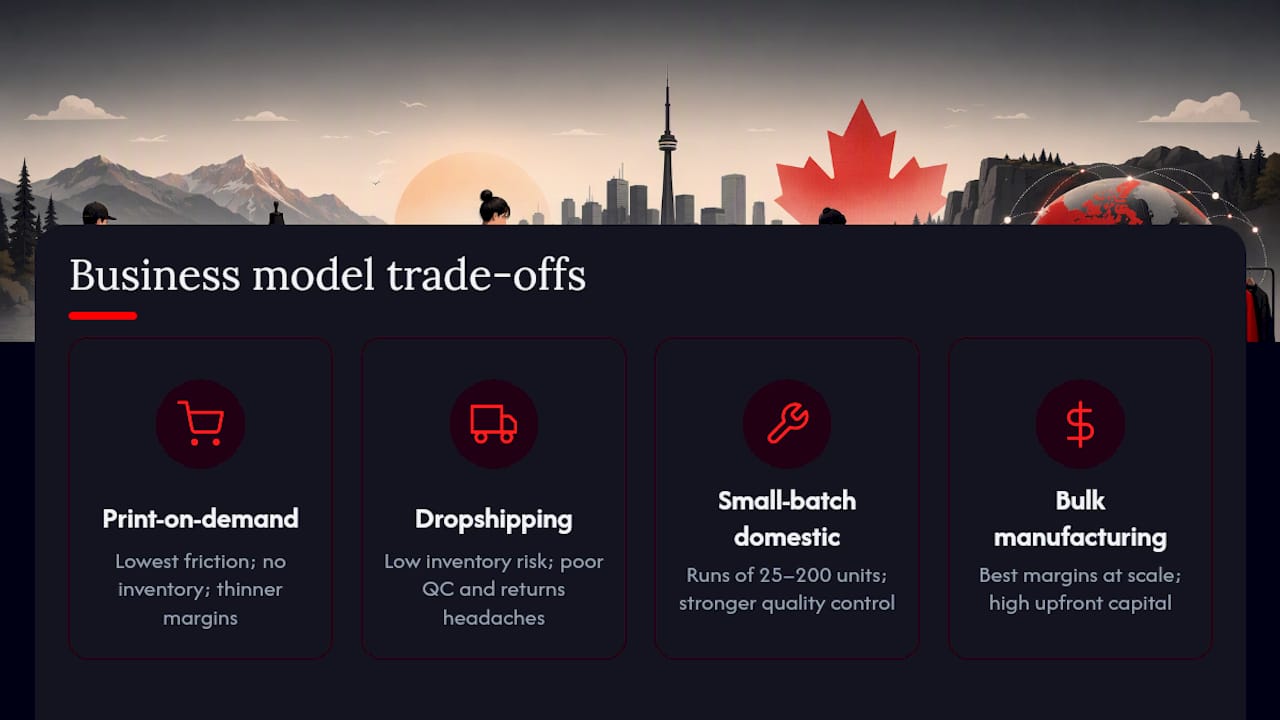
Print-on-demand is the lowest-friction entry point. You upload a design, a supplier prints and ships per order, and you never touch inventory. The tradeoff is real: you’re limited to whatever blank garments and print methods your supplier offers, and margins per unit are thinner than bulk production. Printful’s Canada-focused guidance notes that choosing Canadian fulfilment for POD orders avoids cross-border duties and speeds up delivery to domestic customers, which matters a lot if most of your buyers are in Canada.
Dropshipping works similarly but usually sources from generic overseas catalogs rather than custom-printed garments. Inventory risk stays low, but quality control and returns become genuine headaches since you rarely see the product before a customer does.
Small-batch domestic production means working with a Canadian cut-and-sew shop or local printer for runs of maybe 25 to 200 units. You get real control over fabric weight, fit, and finishing, plus the marketing value of a “made in Canada” label. Per-unit costs run higher than bulk, but the quality gap versus POD is usually noticeable to customers who touch the product.
Bulk manufacturing delivers the best margins once you’re producing hundreds or thousands of units, but it demands upfront capital, longer lead times, and usually a minimum order quantity you need to sell through.
A practical way to decide: if you’re testing a concept, start POD. If you’ve validated demand and fabric quality matters to your niche (think performance layers or premium basics), move to small-batch domestic. Save bulk manufacturing for once you have repeat-purchase data proving people actually want more.
How Much Does It Cost to Launch a Clothing Brand in Canada?
A one-page business plan doesn’t need to be complicated. It needs five things: your value proposition, your target customer, your sales channels, your unit economics, and a rough 12-month budget. Skipping this step is how founders end up with $8,000 in unsold inventory and no idea why.
Here’s what that plan should contain, in order:
- Value proposition. One sentence describing what you make, for whom, and why it beats the alternative.
- Target customer. Age range, general income level, where they shop, and what triggers a purchase.
- Sales channels. Your own store (Shopify is the default for most Canadian founders), plus any marketplaces or wholesale accounts.
- Unit economics. Cost of goods sold (COGS), your markup, and your target margin after shipping and payment fees.
- 12-month budget. Startup costs, monthly running costs, and a break-even estimate.
Startup costs vary enormously by model. A POD launch with a handful of designs and basic branding typically lands between $500 and $2,000, mostly spent on a logo, a Shopify plan, and sample orders. A small-batch domestic run, covering a modest tech pack, fabric sourcing, and a 50 to 100 unit production run, tends to fall between $5,000 and $15,000. Bulk manufacturing with a factory minimum order can easily exceed $20,000 once you include freight, customs handling, and warehousing.
Pricing follows a simple formula: take your COGS (fabric, printing, labor, packaging), then apply a markup that leaves you a healthy margin after payment processing and shipping. If a hoodie costs $18 to produce and you price it at $55, you’re covering costs with room for marketing spend and profit. Break-even happens when your cumulative gross margin covers your fixed launch costs. If your fixed costs are $3,000 and your average margin per hoodie is $30, you need 100 units sold to break even. That’s the kind of math worth doing before you order anything.
Funding for that first run usually comes from one of three places: personal savings, a small business loan through a Canadian bank or credit union, or a crowdfunding campaign that doubles as a preorder validation tool. A well-run business plan, as Square’s guidance for new business owners notes, stops founders from overspending on inventory and marketing before they’ve actually confirmed demand exists.
What Legal Steps Do You Need to Start a Clothing Brand in Canada?
Registering your business is less intimidating than it sounds, and getting it right early saves you from tax headaches later. Your first real decision is structure: sole proprietorship or incorporation. A sole proprietorship is cheaper and simpler to set up, and it works fine for most first-year clothing brands. Incorporating costs more and adds paperwork, but it separates your personal assets from business liability, which matters more once you’re signing supplier contracts or hiring staff.
Whichever structure you pick, you’ll need a Business Number (BN) from the Canada Revenue Agency to open business bank accounts, file taxes, and handle payroll if you hire anyone. The CRA’s Business Number program ties your various tax accounts, corporate tax, payroll, GST/HST, together under one identifier.
Here’s the checklist most founders miss steps on:
- Register your business name provincially (or federally, if you plan to operate across multiple provinces) before you print a single label.
- Apply for your BN through the CRA as soon as you’re selling, not after your first big month.
- Register for GST/HST once you’ve collected more than $30,000 in revenue over four consecutive calendar quarters, since CRA guidance makes this threshold mandatory, not optional.
- Check your municipality’s business license requirements, especially if you’ll run pop-ups or operate from a home studio. CRA’s small-business setup page points founders toward BizPaL for permit lookups.
- Set up a payroll account and register for workers’ compensation coverage the moment you bring on your first employee, not months later.
Trademark protection is worth doing earlier than most founders think. Your brand name and logo are your most valuable long-term assets, and someone else registering them first can be a costly mistake to unwind. The Canadian Intellectual Property Office’s trademark guide walks through the registration process, and it’s worth starting a search before you commit to a name across packaging, social handles, and a domain.
Pro Tip: Search your brand name on CIPO’s trademark database before you order a single hang tag. Rebranding after you’ve printed labels and built a following is far more expensive than a search that takes ten minutes.
How Do You Go From Sketch to Sample With a Canadian Supplier?
Every design needs a tech pack before a supplier can quote it accurately. A tech pack is a simple document with your flat sketch, measurements, fabric specs, and print or embroidery placement. Founders who skip this step end up playing a frustrating game of back-and-forth email corrections, or worse, receiving a sample that doesn’t match what they pictured. Guidance on product development for first-time founders covers this prototyping stage in more depth, and the core lesson holds across industries: precise specs upfront save money and time later.
Once your tech pack is ready, you have three realistic supplier paths in Canada:
- Local sewing shops and small-batch manufacturers, often found in Toronto, Montreal, or Vancouver’s garment districts, offer better communication and faster sample turnaround since there’s no overseas shipping delay.
- Canadian POD services with domestic fulfillment, which skip cross-border duties and get products to customers faster, are ideal for testing designs before committing to inventory. Comparing DTF transfer options built for apparel brands is a useful step here, since print method affects both cost and how the finished garment feels.
- Overseas bulk manufacturers, typically in Asia, offer the lowest per-unit cost at scale but require navigating longer lead times, larger minimum order quantities, and import duties once goods cross into Canada.
Whichever route you choose, negotiate MOQs honestly. Many small manufacturers will flex on minimums for a second or third order once you’ve proven you’re a reliable, repeat customer. Before approving a production run, run every sample through basic quality-control checkpoints: seam strength, color consistency, wash-test shrinkage, and print or embroidery durability after a few wash cycles. A supplier-evaluation checklist helps catch quality issues before they turn into customer complaints. If you’re sourcing overseas for a Canada-focused audience, factor in customs clearance time and duty rates when calculating your landed cost per unit, not just the factory quote.
What Labeling and Safety Rules Apply to Clothing Sold in Canada?
Canadian labeling rules aren’t optional extras. They’re federal law, and getting them wrong can mean product recalls or fines, not just an annoyed customer. Every garment sold in Canada needs three core label elements: fiber content, care instructions, and country of origin.
The Textile Labelling Act sets these requirements specifically for textile products, and it applies whether you’re printing one shirt or ten thousand. On top of fiber and care details, Canada’s bilingual labeling expectations mean many founders print both English and French on care tags, particularly if products will be sold nationally or through larger retail and marketplace channels.
Beyond labeling, the Canada Consumer Product Safety Act governs general product safety for consumer goods, including apparel. This matters most for specific categories:
- Children’s sleepwear has flammability testing requirements that apply regardless of who manufactures it.
- Drawstrings on children’s clothing face specific safety restrictions tied to strangulation risk.
- Any garment with small attached decorations (buttons, sequins, hardware) marketed to young children may trigger choking-hazard testing.
If your niche touches kids’ clothing at all, run safety testing before your first production run, not after a complaint. For standard adult apparel, correct labeling and basic quality checks typically cover your compliance obligations.
How Should You Set Up Sales Channels for a Canadian Clothing Brand?
Most Canadian founders build their store on Shopify because it handles Canadian tax settings, multiple currencies, and local payment methods (Interac, major credit cards) without much configuration work. Shopify’s own launch framework walks through setup, and the priority order matters: get your payment gateway and shipping rates configured correctly before you spend a dollar on ads, since a broken checkout kills conversions faster than weak marketing.
Marketplaces versus an owned store is a real trade-off, not a simple upgrade path. A marketplace listing gets you discovery traffic without building an audience from scratch, but you’re competing on price against everyone else in the category and paying a transaction cut. An owned Shopify store gives you full control over branding, customer data, and margins, but you have to drive your own traffic.
For selling across Canadian cities beyond your own storefront:
- Pop-up shops in cities like Toronto, Calgary, or Halifax let you test in-person demand and collect direct feedback before scaling online spend.
- Wholesale outreach to independent boutiques works well once you have consistent production quality and can meet reorder timelines reliably.
- A point-of-sale setup (many Shopify-integrated POS systems handle this) is worth having ready before your first pop-up, since fumbling payment at a market table costs you sales.
On fulfillment, decide early whether you’ll pack orders yourself, use a third-party logistics provider, or lean on POD for orders outside your home base. Shipping within Canada avoids the duties and customs delays that come with cross-border fulfillment, which is part of why Canadian-based fulfillment for POD orders tends to perform better for domestic-focused brands than routing everything through a US warehouse.
What Does a 90-Day Marketing Launch Plan Look Like?
A launch that works usually follows a predictable sequence: build anticipation, gather emails, sell before you have full inventory, then scale what’s already converting. Here’s a practical 90-day structure that fits most Canada-focused apparel launches:
- Weeks 1 to 3: Pre-launch foundation. Build a simple landing page with an email waitlist, start posting behind-the-scenes design content, and send free samples to a handful of small local influencers or micro-creators in your niche.
- Weeks 4 to 6: Preorder window. Open preorders to your waitlist before full inventory exists. This validates demand and generates cash flow to fund your first real production run.
- Weeks 7 to 9: Public launch. Push content across Instagram and TikTok, since both platforms remain the strongest organic channels for apparel discovery among Canadian shoppers, and layer in a small paid ad budget targeting lookalike audiences from your waitlist.
- Weeks 10 to 13: Retention and local push. Start email marketing sequences for repeat purchases, pitch local Canadian lifestyle or fashion outlets for coverage, and consider a pop-up in your home city to convert local buzz into in-person sales.
Paid strategy should prioritize retargeting website visitors before you chase new cold traffic. Retargeting ads typically convert far more efficiently than cold prospecting, especially in the first few months when your budget is tight.
Pro Tip: Send your first samples to five to ten real customers, not influencers, before your public launch and ask for honest feedback on fit and fabric. That feedback loop matters more than follower counts at this stage.
How Do You Handle Fulfillment and Returns as a Small Team?
Your fulfillment choice shapes your customer experience more than almost any other operational decision. Pick-and-pack fulfillment, where you or a small team hand-pack orders from held inventory, gives you speed and control but requires upfront capital tied up in stock. POD flips that trade-off: no inventory risk, but longer per-order production time and less say over exact materials.
A returns policy needs to be simple enough that customers understand it before they buy, and generous enough that hesitant first-time buyers feel safe purchasing. A common structure that works for small Canadian apparel brands: 30-day return window from delivery date, unworn items with tags attached, and either a refund or store credit at the customer’s choice. Posting this clearly on your product pages, not buried in fine print, measurably reduces pre-purchase hesitation.
For inventory itself, small brands generally do better avoiding large speculative buys early on. Three tactics reduce risk:
- Preorder your first run based on actual demand signals from your launch waitlist rather than guessing quantities.
- Made-to-order production for slower-moving items keeps cash from sitting in unsold stock.
- Small buffer stock only for your proven best-sellers, once sales data tells you which designs actually move.
Bulk ordering for events or teams follows different logic entirely, and founders exploring company apparel and workwear workflows will notice that predictable, contracted volume changes the calculation compared to unpredictable retail demand.
When Are You Ready to Scale Your Clothing Brand?
Scaling too early is one of the most common ways Canadian apparel founders burn through their capital. The signals worth watching are specific, not vague gut feelings about momentum.
Reorder rate is the clearest one: if a meaningful share of your customers come back for a second purchase within a few months, your product and fit are resonating. A healthy LTV to CAC ratio (lifetime value against customer acquisition cost) of roughly 3 to 1 or better suggests your marketing spend is sustainable, not just producing one-time sales. Consistent margins across multiple production runs, not just your first lucky batch, confirm your unit economics actually hold up at volume.
Once those signals are solid, scaling options include:
- Moving from small-batch domestic production to a bulk manufacturing contract that lowers per-unit cost.
- Expanding into wholesale accounts with boutiques or regional retailers who’ve already shown interest.
- Adding a second sales channel, whether that’s a new marketplace or a physical pop-up presence in a second city.
Your first hires usually follow a predictable order: a part-time fulfillment or packing helper first, then customer service support once order volume makes same-day replies hard to manage alone, and eventually a production manager once you’re juggling multiple supplier relationships at once. Hiring ahead of demand drains cash fast. Hiring right after you hit these signals keeps growth funded by revenue instead of debt.
When Does a Local GTA Print Partner Make Sense?
Not every stage of your brand needs an overseas factory or a POD platform. Sometimes the fastest, most reliable move is a local printer who can turn around samples in days instead of weeks. This matters most in three specific situations: when you need a physical sample before committing to a bulk order, when you’re filling a rush order for a pop-up or event, and when you’re building a small-batch drop and want direct quality control over the print itself.
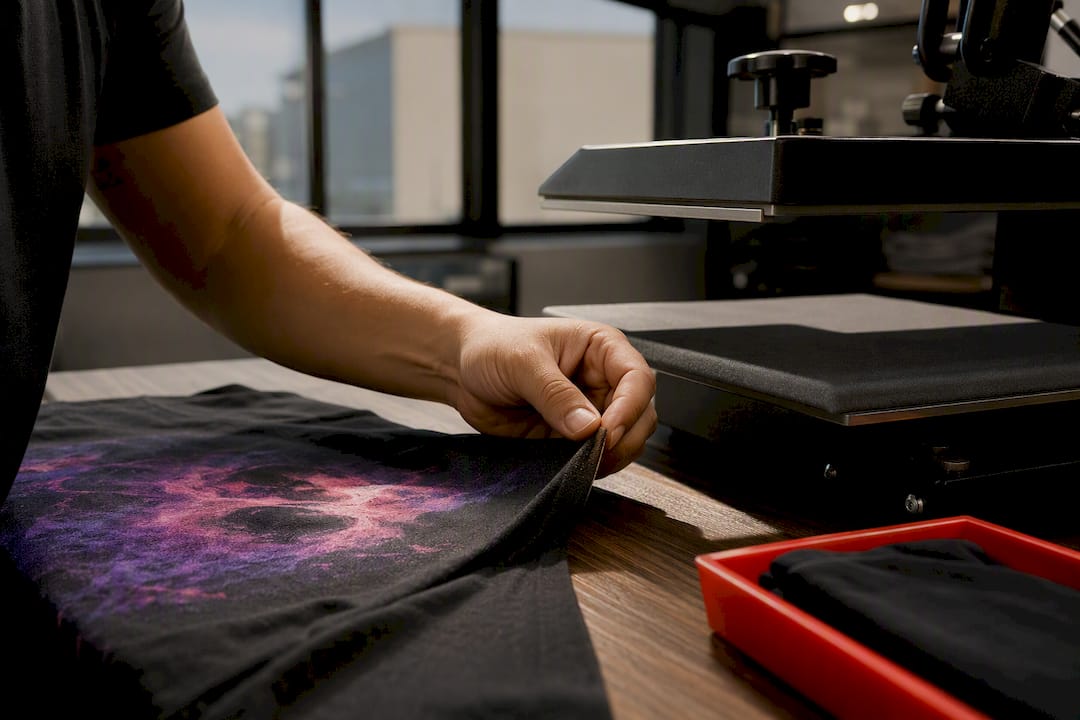
Some local print shops work with individuals and businesses who need exactly this kind of flexibility. Printing options like full-color DTF and screen printing cover many apparel needs, from single test samples to bulk team orders, and both custom garment printing and ready-made printed products may be available depending on whether you’re designing from scratch or need something faster. Local pickup options can cut shipping time for founders who want a same-week sample in hand.
When evaluating a local printer against a POD platform, weigh these factors:
- Speed to sample. A local printer can often turn a design into a physical sample faster than a POD platform’s standard production queue.
- Material control. Working locally lets you request specific blank garments and print placements that some POD catalogs don’t offer.
- Cost at small volume. For runs under 50 units, local printing often beats per-unit POD pricing once you factor in shipping.
- Scalability. POD still wins for founders who need automated order-by-order fulfillment without any hands-on packing.
A hybrid approach works for many founders: use a local partner for your first samples and any rush or pop-up runs, then layer in POD or bulk manufacturing once your core designs are validated.
Do You Need a Trademark or Copyright to Protect Your Clothing Designs?
Trademark and copyright protect different things, and mixing them up is a common founder mistake. A trademark protects your brand name, logo, and any distinctive slogan tied to your business identity. Copyright protects original creative works, including specific print designs, graphics, or illustrations you put on a garment, automatically the moment you create them, without needing to register anything.
Trademark registration is the one that actually requires action on your part. The CIPO trademarks guide explains that registering formally gives you exclusive legal rights to use your brand name and logo across Canada, and it makes enforcement against copycats far simpler than relying on unregistered common-law protection alone.
Here’s the practical order most founders should follow: search the CIPO trademark database before finalizing your brand name, file your application once you’ve settled on a name and logo you’re committed to, and keep records (dated files, sketches, production notes) of your original graphic designs in case you ever need to prove authorship in a copyright dispute. Registration isn’t instant. CIPO applications can take months to process, so starting early, ideally before your public launch, avoids a situation where you’ve built brand recognition around a name you don’t legally control yet.
For founders working with outside designers or freelance illustrators, get copyright ownership terms in writing before the project starts. Without a clear agreement, the designer may retain rights to work you paid for, which becomes a real problem if you want to print that design on more than one product line.
What Financing Options Exist for Canadian Clothing Entrepreneurs?
Most first-time apparel founders in Canada fund their launch through a combination of personal savings and small revenue from early preorders, but that’s rarely the only option worth exploring. Traditional bank loans and lines of credit through Canadian credit unions remain a common path, particularly for founders with an established credit history or existing collateral. Approval typically requires a business plan and revenue projections, which is another reason that one-page plan matters beyond just your own clarity.
Government-backed financing is worth investigating before assuming you’re on your own. Regional and federal small-business support programs periodically offer loans or grants aimed at manufacturing, retail, or export-focused ventures, and eligibility often depends on your province, business structure, and growth stage. Checking your provincial economic development office and the federal Canada Business network is a reasonable first step before applying anywhere else.
Crowdfunding deserves more attention than founders usually give it. A well-run campaign does double duty: it raises production capital and validates real demand simultaneously, since strangers paying upfront for a product that doesn’t exist yet is stronger proof than any market research survey.
Angel investors and small equity investors are less common for early clothing brands than for tech startups, but they do exist, particularly once a brand has proven repeat sales and a clear growth trajectory. Most investors want to see traction first, meaning this option usually fits better after your launch than before it. For most founders reading this before their first sale, the realistic order is: personal savings first, preorders or crowdfunding second, formal loans once you have revenue history to show a lender.
What Import Duties and Compliance Rules Apply to Sourced Apparel?
If any part of your supply chain crosses the border, whether that’s fabric, finished garments, or trims imported from overseas manufacturers, customs duties and import compliance become part of your cost structure, not an afterthought. Duty rates vary by garment category and country of origin, so get an accurate landed-cost quote from your supplier or a customs broker before finalizing pricing, not after goods arrive at the port.
Beyond duties, Canadian apparel sellers face a few compliance areas that go past basic labeling. Flammability standards apply to specific product categories, notably children’s sleepwear, regardless of where the garment was manufactured. Any imported textile still needs to meet the same fiber-content and country-of-origin labeling rules that apply to domestically produced goods, so a supplier’s overseas label often needs supplemental Canadian labeling before the product reaches a customer.
If you’re importing finished goods rather than raw materials, factor in the paperwork: a commercial invoice, accurate tariff classification, and proof of origin documentation are typically required for customs clearance. Working with a customs broker for your first few shipments is worth the fee, since misclassified goods can trigger delays or unexpected duty assessments that eat into your margin.
For founders sticking to domestic small-batch production or Canadian-fulfilled POD, most of this section simply doesn’t apply, which is one more reason many first-time brands start there. It removes an entire layer of regulatory complexity while you’re still validating your product.
How Do You Build a Brand Identity That Resonates With Canadian Shoppers?
Branding is more than a logo. It’s the consistent story your visuals, tone, and product choices tell across every touchpoint a customer sees, from your Instagram grid to the hang tag on a hoodie. Start with your core visual assets: a logo that works in both color and single-color print (since screen printing and embroidery often require simplified versions), a defined color palette, and a consistent typography choice across packaging and your online store.
Canadian shoppers respond well to authenticity signals that feel specific rather than generic. Referencing real regional context, whether that’s a design inspired by a specific city’s skyline or fabric weight built for actual Canadian winters, tends to land better than vague “Canadiana” branding built on maple leaves and little else. The Nelo brand profile mentioned earlier makes a similar point: leading with tangible product quality, fabric weight and fit specifically, builds more credibility with Canadian buyers than leaning purely on national pride imagery.
Packaging and unboxing matter more than most founders expect, especially for a brand without physical retail presence. A simple branded tissue wrap or a thank-you card with your story costs very little but meaningfully increases the chance a customer posts about their purchase, which is often your cheapest form of marketing.
Keep your brand voice consistent across every channel before launch, not after. Decide early whether your tone is playful, minimalist, or aspirational, and apply that same voice to your product descriptions, your social captions, and your customer service replies. Inconsistency here is subtle but it erodes trust faster than founders realize.
How Sustainable and Ethical Can a New Canadian Clothing Brand Be?
Sustainability claims carry real weight with Canadian shoppers, but they also carry real scrutiny, so vague language like “eco-friendly” without specifics tends to backfire. Founders who want to build ethical sourcing into their brand from day one have a few concrete levers available.
Fabric choice is the most direct one. Organic cotton, recycled polyester blends, and Canadian-milled fabrics each carry different cost and environmental trade-offs worth researching against your specific product before you commit to a supplier. Domestic small-batch manufacturing inherently reduces the shipping footprint compared to overseas bulk production, which is a genuine environmental advantage even if it’s not the main reason most founders choose that model.
Labor practices matter just as much as materials, particularly if you’re sourcing overseas. Ask any manufacturer directly about their labor certifications and working conditions before signing a production agreement, and treat a vague or dismissive answer as a warning sign. Founders working with Canadian small-batch shops get an easier path here, since local labor standards are already governed by provincial employment law.
Waste reduction is worth building into your model from the start rather than retrofitting later. Made-to-order and preorder production models, discussed earlier for inventory management, also happen to reduce unsold overstock ending up in landfills, which is one of the apparel industry’s most persistent waste problems. Packaging choices, recyclable mailers over excess plastic, are a smaller but visible signal to environmentally conscious buyers.
None of this needs to be perfect at launch. It needs to be honest. Overstating your sustainability credentials to a skeptical customer base does more damage than simply describing your actual practices plainly.
How Do You Build Strong Supplier Relationships in Canada?
A good supplier relationship is worth more than a slightly cheaper quote from a stranger overseas, especially in your first year when you can’t yet predict demand precisely. Canadian manufacturers and print shops tend to offer faster communication, easier in-person quality checks, and more flexibility on small reorders than distant overseas factories that prioritize their largest accounts.
Finding the right local partner starts with research specific to your product category. Garment districts in Toronto, Montreal, and Vancouver house small cut-and-sew operations that specialize in different apparel types, so a supplier great at knitwear may not be the right fit for structured outerwear. Trade groups and local business associations in these cities often maintain directories worth checking before you cold-call a list of names online.
Once you’ve identified a few candidates, request a small paid sample run before committing to your first real production order. This costs a little money upfront but reveals communication quality, turnaround honesty, and actual product quality far better than a phone call ever will. Pay attention to how a supplier handles a mistake or delay during that sample process. That’s usually a better predictor of the working relationship than their initial pitch.
Treat your suppliers as long-term partners rather than one-off vendors. Founders who pay on time, communicate order changes early, and give honest feedback tend to get better treatment on future MOQs and rush requests. A supplier who trusts that you’ll place a second order is far more likely to accommodate the kind of flexibility a growing brand needs, whether that’s a smaller test batch or a rushed reorder before a big sales weekend.
Lessons From Watching Canadian Apparel Founders Launch and Stumble
The founders who make it past their first year almost always share one trait: they resist the urge to over-order before they’ve proven anything. It’s tempting to place a bigger production run because the per-unit price drops, but that math only works if the units actually sell. A smaller batch that sells out fast builds more useful momentum than a large batch that lingers in a closet for eight months.
Testing assumptions early matters more than most founders expect going in. The niche you think you’re serving and the one that actually buys are sometimes different, and the only way to find out is to sell something small before scaling anything. Fabric and fit are worth genuine investment even on a tight budget, since customers notice the difference between a garment that drapes well and one that doesn’t, even if they can’t articulate why.
Local partners earn their place when speed or control matters more than the lowest possible unit cost, whether that’s a rush sample before a pitch meeting or a small print run for a pop-up next weekend. And the brands that last tend to treat their early collections as a feedback loop, not a finished product. Reorder patterns tell you more about what to make next than any planning spreadsheet ever will.
— Toronto
Need Samples Fast? A Local Print Partner Beats Waiting on Overseas Shipping
Waiting two to three weeks for an overseas sample to arrive can stall an entire launch timeline. Torontocustomtshirts gives founders in Mississauga, Toronto, and the GTA a faster alternative for the moments that matter most: your first sample run, a rush order before a pop-up, or a small-batch drop where fabric and print quality need to be right before you commit to bulk.
Services include full-color DTF printing, screen printing, custom garment printing with print-ready artwork support, and ready-made printed products for founders who need something quickly without a full custom design process. Local pickup in Mississauga means you can hold a finished sample in your hands the same week, not the same month, and both personal orders and business or bulk team orders are handled with the same fast turnaround. Whether you’re testing a first hoodie design or filling a 100-unit team order before an event, Torontocustomtshirts can quote your run and get product moving. Visit the Toronto custom apparel page to check turnaround times and start your first order, or explore bulk pricing for larger runs once your first collection is ready to scale.
Where to Verify These Canadian Business Requirements
Every legal and regulatory step covered above traces back to a specific government source, and it’s worth bookmarking these before you file anything.
- CRA’s Business Number program covers BN registration and the $30,000 GST/HST threshold.
- CIPO’s trademark guide walks through searching and registering your brand name.
- The Textile Labelling Act sets the fiber content, care, and origin labeling rules every garment sold in Canada must follow.
- Shopify’s Canadian launch framework and Square’s step-by-step guide both offer practical, non-legal checklists worth cross-referencing against your own plan.
Confirm details directly on these sites before making a final registration or filing decision, since requirements can shift by province and by year.
Sources
- Canada Revenue Agency — Business Number program
- Canadian Intellectual Property Office — Trademarks guide
- Justice Laws Website — Textile Labelling Act
- Shopify Canada — How To Start a Clothing Brand in 14 Steps (2026)
Recommended
Get pricing in 24h.
Toronto-based, no minimums. Tell us about your project and we'll email a detailed quote within one business day.
Request a Quote