Hit 55–70% Margins: Band Merch Pricing That Covers Unit Cost
Use 2026 benchmarks and a landed cost formula to price band merch for 55–70% margins, with bundle tactics, break even math, and print quotes.

Hit 55–70% Margins: Band Merch Pricing That Covers Unit Cost
Price merch to cover true unit cost and land a 55–70% gross margin on apparel; use Retail price = True unit cost ÷ (1 − target gross margin). A shirt costing $12 landed at a 60% margin target sells for $30. Stickers and pins can run 70%+ margin since production costs stay near zero. The math below shows exactly how to get there, channel by channel.
TL;DR:
- Band merch prices should be set to achieve a 55–70% gross margin, with typical retail prices around $30–$40 for T-shirts in 2026.
- The true unit cost calculation must include blank garment costs, print fees, setup, freight, packaging, spoilage, and processing or platform fees.
- Different sales channels such as venues, online stores, and platforms like Bandcamp significantly affect the final price and net profit, requiring channel-specific pricing adjustments.
- Bundling and tiered pricing strategies can increase revenue and engagement, with entry, core, and premium options tailored to different fan segments.
- Always analyze sales data and test price adjustments to optimize margins, recognizing how fan demographics and demand elasticity impact what can be charged at each event or platform.
Table of Contents
- What Goes Into True Band Merch Pricing?
- 2026 Price Benchmarks and Margin Targets by Product Type
- How Does Sales Channel Change Your Merch Pricing?
- Bundle Strategy: Building an Entry, Core, and Premium Lineup
- Break-Even Math and Inventory Planning
- Pricing Tactics That Let You Charge More Without Losing Fans
- Common Merch Pricing Mistakes and Negotiating Venue Cuts
- Seasonal and Promotional Discount Strategies
- How to Test and Adjust Merch Prices Based on Sales Data
- Legal Considerations in Band Merch Pricing and Branding
- How Fan Demographics and Demand Shape What You Can Charge
- Treat Merch as Part of the Business, Not an Afterthought
- How Toronto Custom T-Shirts Helps You Price and Print Smarter
- Sources
- FAQ
What Goes Into True Band Merch Pricing?
Most bands underprice because they only think about the blank shirt and the print job. That’s maybe half the real cost.
A true unit cost calculation needs every one of these lines:
- Blank garment cost (the shirt, hoodie, or hat itself)
- Print or embroidery cost per unit
- Setup or screen fees, divided across the run
- Inbound freight to get product to you
- Packaging materials (poly bags, tags, boxes)
- Spoilage and damage allowance, typically 3-5% of a run
- Payment processing fees, such as Stripe’s roughly 2.9% plus $0.30 per transaction
- Platform fees if selling online, like Bandcamp’s 10% cut on physical merch
- Venue commission if selling at a show
- Sales tax, where applicable to your setup
Once you have that number, the formula is simple: Retail price = True unit cost ÷ (1 − target gross margin).
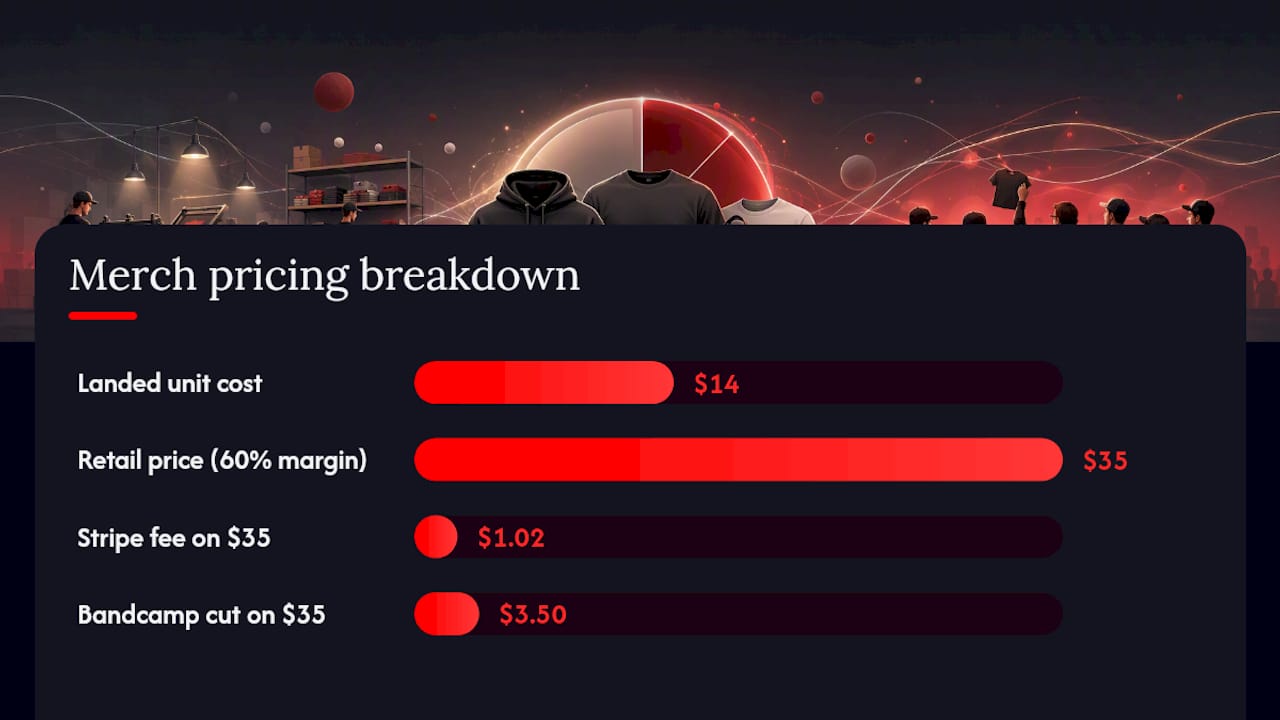
Say a tee costs $14 landed (blank, print, packaging, spoilage allowance) and you want a 60% margin. $14 ÷ (1 − 0.60) = $35. That’s your merch-table price before any venue cut. Now run the online version: same $14 unit cost, but add $1.02 in Stripe fees and a $3.50 Bandcamp cut on a $35 sale. That gap between gross and net is exactly why so many bands feel like they’re making money at the table but somehow broke by the end of tour.
Pro Tip: Build a simple spreadsheet with one row per SKU and round every price to a clean number ($20, $30, $45) before you print price signs. Fans decide faster at round numbers, and you avoid fumbling with change at a dark merch table.
2026 Price Benchmarks and Margin Targets by Product Type
Merch pricing has drifted upward. Standard T-shirts at independent shows were tracking around $30 to $40 in 2026, averaging near $37 to $38, with hoodies averaging about $70. If your prices sit well under that, you’re likely leaving money on the table, not winning fan loyalty.
| Product | Typical 2026 retail range | Target gross margin |
|---|---|---|
| Stickers | $2–$5 | 70%+ |
| Pins/buttons | $3–$8 | 70%+ |
| Posters | $10–$25 | 60–70% |
| Tote bags | $12–$20 | 55–65% |
| Standard tees | $30–$40 | 55–70% |
| Long sleeves | $35–$45 | 50–65% |
| Hats | $25–$35 | 55–65% |
| Hoodies | $60–$70 | 50–65% |
| Vinyl (LP) | $25–$35 | 35–60% |
| CDs | $10–$15 | 40–55% |
| Cassettes | $8–$12 | 45–60% |
| Bundles | Varies (see below) | 45–60% |
Small goods like stickers and pins can carry margins of 600% or more, which is why smart bands stock them even though the dollar total per sale is small. They subsidize the table and give budget-conscious fans a way to buy something.
Vinyl sits lower on margin because pressing costs stay stubbornly high, but collector variants change that math. Treat these ranges as market averages for 2026, not hard rules; a band with strong regional demand can price above them without losing sales.
How Does Sales Channel Change Your Merch Pricing?
The same shirt should not necessarily sell for the same price everywhere. Every channel takes its own cut, and pricing flat across all of them quietly punishes you in whichever channel has the highest fees.
- Live shows: Venue commissions typically run 10-40%, with many rooms landing at 20-25%, and that cut usually applies to gross sales, not net profit.
- Online store (your own site): Payment processing runs about 2.9% plus $0.30 per transaction, plus you absorb shipping unless you build it into price.
- Marketplace platforms: Bandcamp takes 10% on physical merch, on top of your own shipping and packaging costs.
- Print-on-demand (POD): No upfront inventory risk, but POD shirts often need retail prices of $35 to $45 to hold a healthy margin, versus $30 to $40 for bulk-printed runs.
Run the same $35 tee through all three and the differences show up fast. Sold through your webstore, you net closer to $33.70 after processing fees, minus shipping. That’s why a lot of touring acts either quietly adjust merch-table pricing upward to absorb the venue cut, or put up a sign steering fans to a QR code for the webstore, where the band keeps more of every dollar.
Bundle Strategy: Building an Entry, Core, and Premium Lineup
A flat table of individually priced items leaves money on the table compared to a structured tier system. Three tiers give every fan, from casual to superfan, a natural price point to land on.
- Entry tier ($5–$15): stickers, pins, patches, small posters. Low commitment, high margin, and often an impulse buy near the register.
- Core tier ($25–$45): standard tees, hats, totes, CDs. This is where most transactions happen and where your margin targets matter most.
- Premium tier ($60–$100+): hoodies, vinyl, signed items, and bundles. Fewer buyers, but each sale carries real weight.
Bundling across tiers raises average order value with almost no added cost. A shirt plus vinyl bundle priced at $10 off the combined total feels generous to the fan while increasing cash flow and perceived value for the band. Recommended discount bands run $5 to $15 depending on bundle total, enough to feel like a deal without eating your margin.
Album drop bundles (vinyl plus tee plus digital download code) and collector bundles (numbered print plus signed insert) both work well here.
Pro Tip: A numbered or signed extra costs you almost nothing to add but lets you charge a genuine premium. Fans aren’t paying for the sharpie mark. They’re paying for the story they get to tell about it.
Break-Even Math and Inventory Planning
Before you order a single box, work out how many units you need to sell to cover the print run. The formula: Fixed production cost ÷ net revenue per unit = units to break even.
Say a 200-unit tee run costs $1,800 total (blanks, print, setup, freight). At a $35 retail price with roughly $15 in true unit cost, net revenue per unit is $20. $1,800 ÷ $20 = 90 units to break even. Sell through half your run and you’re already profitable.
Now compare that to a 1,000-unit run. Per-unit costs typically drop because setup fees spread thinner, maybe down to $10 true cost, pushing net revenue per unit to $25. But your fixed cost jumps to roughly $7,500, meaning you need to move 300 units before you see a dollar of profit. Bigger runs lower your per-unit cost but raise your break-even bar and your inventory risk.
- Model each SKU separately, then combine them into one spreadsheet to see your total break-even across the whole merch line.
- A merch profit calculator speeds this up considerably once you know your cost inputs.
- Always include a spoilage and inbound freight allowance in the unit cost before you calculate break-even, or you’ll underprice and get surprised later.
Pricing Tactics That Let You Charge More Without Losing Fans
Small upgrades often justify bigger price jumps than the upgrade actually costs you. Spending roughly $3 more per unit on a premium blank can support a $10 retail increase, which is a far better return than cutting corners to save that same $3.
- Puff print or embroidery instead of flat screen print signals quality at a glance, even before a fan touches the fabric.
- Colored vinyl variants or splatter pressings routinely support a $5-$10 premium over standard black vinyl.
- Limited runs (100 units, numbered) use scarcity to support $10-$15 price bumps without complaint.
- A well-lit, organized merch table with a staffer who can talk about the designs sells more than a folded pile on a folding chair.
- Test a premium SKU through print-on-demand before committing to a bulk run, so you’re not stuck with 200 units of a design nobody wanted.
Pro Tip: A heavier, better-fitting blank photographs better on Instagram too, which means fans do some of your marketing for free just by wearing it.
Common Merch Pricing Mistakes and Negotiating Venue Cuts
Bad pricing usually comes from a short list of repeatable errors:
- Pricing off print cost alone and forgetting freight, spoilage, and fees.
- Ignoring payment processing and platform cuts when setting online prices.
- Understocking premium items, then missing the sales that would have paid for the whole run.
- Skipping bundles entirely and leaving average order value on the table.
Venue commissions complicate things further. Cuts typically apply to gross revenue, not net profit, so a 25% cut on a $35 shirt takes $8.75 regardless of what you paid for it. Ask promoters directly whether the percentage is negotiable, whether a flat table fee is an option instead, and whether the cut applies only to apparel or to everything including stickers.
When a venue’s cut is high, either build it into your merch-table price or lean harder on your webstore, where fans pay less and you keep more.
Seasonal and Promotional Discount Strategies
Discounting merch works, but only when it’s timed to protect margin rather than just move inventory out of panic.
Album release weeks are the opposite case: raise urgency instead of cutting price, using limited bundles or numbered variants rather than a discount.
A useful rule: discount slow-moving inventory, never your best sellers. If a hoodie color sells through in the first two shows of a tour, it doesn’t need a sale. If a long sleeve design has sat flat for a month, a temporary $5 markdown clears it faster than letting it ride the whole tour unsold. Flash discounts tied to a specific show or livestream (“merch discount code for tonight’s stream only”) also create urgency without permanently devaluing the item, since the price returns to normal the next day.
How to Test and Adjust Merch Prices Based on Sales Data
Treat your first price as a hypothesis, not a final answer. Track units sold per show alongside gross and net revenue for each SKU, even if that tracking is just a notes app after every stop. Patterns show up fast: a tee that sells briskly at $30 but barely moves at $35 is telling you something real about that specific fan base’s price sensitivity.
Run small experiments rather than sweeping repricing. Test a $5 increase on one SKU for a handful of shows while holding everything else steady, then compare unit velocity before and against after. If sales barely dip, the increase is pure margin gain. If sales fall off a cliff, you found the ceiling.
Direct fan feedback matters too. If people are commenting that merch feels expensive relative to comparable acts, that’s worth weighing against your actual cost data, since fans often underestimate touring and production costs. If nobody complains and the table sells out early, that’s a signal you priced too low, not that you got lucky.
Legal Considerations in Band Merch Pricing and Branding
Pricing itself carries few legal landmines, but the branding attached to it does. Make sure your band name, logo, and any artwork you print are either originals or properly licensed; using unlicensed images, fonts, or characters on merch you sell for profit creates real trademark and copyright exposure regardless of your pricing strategy.
If you sell merch under an LLC or partnership, keep a clear paper trail of what revenue is merch versus ticket or streaming income, since tax treatment can differ. Sales tax collection rules vary by jurisdiction and by where you’re physically selling (a touring show in one province or state versus your online store), so check your local requirements rather than assuming your webstore’s settings cover every stop on tour. If a printer or supplier requires exclusivity or minimum order clauses in a contract, read those terms before locking in a design, since they can limit your ability to reprint or switch printers later.
How Fan Demographics and Demand Shape What You Can Charge
A band’s fan base sets a real ceiling on pricing, and ignoring that ceiling costs sales even when your margin math looks perfect on paper. A college-town punk act and an arena-adjacent indie band selling the same $40 tee will see very different conversion rates at the merch table, because disposable income and price expectations differ across those audiences.
Younger, budget-conscious fan bases respond better to a strong entry tier: cheap stickers, pins, and patches that convert browsers into buyers even when they can’t justify a $65 hoodie. Older or more established fan bases with more disposable income tend to support premium tiers better, including vinyl and limited collector items, without much price resistance.
Demand elasticity also shifts by moment. A sold-out album release show has fans primed to spend more than a random Tuesday club date, which is exactly when limited bundles and premium variants perform best. Watch how quickly items sell out relative to crowd size at different shows; a design that moves fast at a hometown show but drags at a random tour stop isn’t necessarily priced wrong everywhere. It might just be priced wrong for that specific room.
Treat Merch as Part of the Business, Not an Afterthought
The artist merchandising market is projected to hit $8.53 billion in 2026, and that growth exists because fans want to pay for physical connection to music they care about. Pricing fairly and covering true costs isn’t just about profit margins; it’s what actually funds the next tour, the next pressing, the next studio session. Track your margins per SKU, cut what isn’t pulling its weight, and put merch profit back into the music instead of treating it as pocket change.
— Toronto
How Toronto Custom T-Shirts Helps You Price and Print Smarter
Getting your true unit cost right depends on getting a real quote, not a guess. Custom apparel printing services offer bulk pricing that decreases per-unit cost as run size grows and provide rush turnaround options for urgent deadlines.
Local pickup options can help avoid shipping delays before release events, and detailed quotes break down blank cost, print cost, and setup fees separately, so you can use accurate numbers for pricing calculations instead of estimating. Whether you’re testing a design at 50 units or locking in a 500 unit run for a full tour, Torontocustomtshirts works with both personal and bulk business orders.
Request a quote and ask specifically for a full landed cost breakdown by unit. Once you have real numbers instead of estimates, the margin math in this guide takes about five minutes to run for your entire merch line.
Sources
The benchmarks and margin targets above draw from Sonicbids’ pricing guide, Hypebot’s musician margin guide, the Tools4Music merch profit calculator, and Concerts Remembered’s reporting on venue commissions. Run your own numbers through the calculator before your next print order, and check the bulk printing cost breakdown for a closer look at how setup fees and volume affect your per-unit price.
- How to Price Your Band Merch: T-Shirts, Vinyl, Bundles & More
- Musician’s guide to merch margins 2026
- Merch Profit Calculator | Calculate T-Shirt, Vinyl & Merch Margins | Tools 4 Music
FAQ
How Much Should Band Merch Cost to Produce?
True unit cost includes the blank, print, setup, freight, packaging, spoilage allowance, and any payment processing or platform fees, which together typically land around $10 to $15 for a standard tee depending on run size.
How Much Does Merch Usually Cost at a Show?
Expect $30 to $40 for a standard tee and roughly $70 for a hoodie at most independent shows, with venue commission already factored into that price by the band selling it.
Recommended
Get pricing in 24h.
Toronto-based, no minimums. Tell us about your project and we'll email a detailed quote within one business day.
Request a Quote