
Toronto Buyers: Verify Sustainable T Shirt Printing with GOTS and SDS
Stop greenwash when ordering custom tees in Toronto. Request GOTS or GRS numbers, the ink SDS, and wastewater handling before you place an order.
Toronto Buyers: Verify Sustainable T Shirt Printing with GOTS and SDS
The fastest path to genuinely sustainable custom tees is on-demand printing on GOTS-certified organic cotton or certified recycled blanks, using water-based DTG or DTF transfers, or certified low-waste screen printing. This approach cuts overproduction, avoids the toxic chemical load of conventional plastisol runs, and leaves a cleaner end-of-life trail. Before you order anything, ask your printer for fabric certification numbers and ink safety data sheets. If they can’t produce them, that’s your answer.
TL;DR:
- Verifiable sustainability depends on matching fabric, ink, and production volume, with certification numbers and documentation essential for truly eco-friendly apparel.
- Organic cotton, recycled polyester, and sustainable fabrics like Tencel and hemp have specific environmental benefits and trade-offs, requiring certification to confirm their claims.
- Small-batch, on-demand printing methods like DTG and DTF reduce overproduction and waste, especially when paired with water-based, certified inks and on-demand fulfillment.
- A supplier’s transparency on documentation, including certification numbers and safety data sheets, is more reliable than vague claims such as “eco-conscious” or “sustainable.”
- Garment longevity, proper end-of-life disposal, and durability significantly impact the true sustainability of a printed T-shirt beyond production.
Table of Contents
- What Makes Sustainable T-Shirt Printing Different From Regular Printing
- Which Fabrics Count as Sustainable Choices and Why
- Printing Methods: Sustainability Profiles and Which to Pick
- Inks, Chemicals, and Certifications: How to Verify Claims
- How to Choose a Genuinely Sustainable Printer (Practical Checklist)
- How Toronto Custom T-Shirts Approaches Sustainable Printing
- Comparing the Environmental Footprint of Each Printing Method
- What Happens to a Sustainable T-Shirt at the End of Its Life
- Brands Actually Getting Sustainable Printing Right
- Where Buyers Get Sustainable Printing Wrong
- Order Sustainable Custom Tees Without the Guesswork
- Sources
What Makes Sustainable T-Shirt Printing Different From Regular Printing
Most “eco” apparel claims fall apart the moment you ask for documentation. Sustainable t-shirt printing isn’t a marketing category. It’s a combination of three verifiable choices: the fiber content of the blank garment, the chemistry of the ink, and the production model that decides how many shirts get made in the first place.
Get any one of those three wrong and the “sustainable” label stops meaning anything. A shirt printed with water-based ink on virgin polyester isn’t sustainable just because the ink is clean. A GOTS-certified organic cotton tee run through a plastisol press with no wastewater treatment isn’t sustainable either. The standard industry term for this full-picture approach is eco-friendly apparel printing, and it only works when fabric, ink, and production volume all point the same direction.
Which Fabrics Count as Sustainable Choices and Why
Fabric choice sets the ceiling on how sustainable a printed shirt can ever be, no matter how clean the ink is.
Organic cotton grown to Global Organic Textile Standard (GOTS) rules skips synthetic pesticides and fertilizers during cultivation. Cotton is biodegradable in principle, but that claim comes with a catch: dyes, finishing chemicals, and the printing method itself determine how cleanly the fabric actually breaks down at end of life. A GOTS certificate on the blank garment matters more than the word “organic” printed on a hang tag.
Recycled polyester (rPET), usually spun from plastic bottles, cuts the carbon footprint of virgin polyester production. The trade-off: it still sheds microplastics in the wash and doesn’t biodegrade, so it just relocates the environmental cost from manufacturing to laundry day.
Recycled cotton reduces water use dramatically compared to growing new cotton, though the shortened fibers usually mean it gets blended with virgin cotton or polyester to hold up structurally.
Tencel (lyocell) and hemp are the fabrics most sustainability-focused apparel buyers overlook. Tencel is made from wood pulp in a closed-loop process that recovers most of its solvents, and hemp needs far less water and no pesticides to grow. Both take water-based inks well, though their tighter weave can soften fine print detail compared to cotton.
A few practical notes on fabric selection:
- Blends print more predictably but complicate end-of-life sorting since mixed fibers can’t be recycled or composted as cleanly as single-fiber fabrics.
- Always ask for the GOTS or Global Recycled Standard (GRS) certificate number, not just a claim of “organic” or “recycled” content.
- Traceability documentation should name the specific mill or supplier, not just a general sourcing region.
Printing Methods: Sustainability Profiles and Which to Pick
The printing method you choose affects water use, chemical exposure, and how much gets wasted per order. Here’s how the main options stack up.
-
Direct-to-Garment (DTG) with print-on-demand. DTG prints one shirt at a time straight from a digital file, which pairs naturally with on-demand fulfillment. That matters because overproduction accounts for a significant portion of global textile waste, and DTG sidesteps the “print 500, sell 200, land fill 300” problem baked into bulk runs. The catch is that DTG only stays clean when the inks themselves are water-based and certified rather than solvent-heavy.
-
DTF (direct-to-film) transfers. DTF prints the design onto a film, then heat-presses it onto the garment. It works on cotton, blends, and polyester alike, which makes it flexible for small businesses ordering mixed fabric types. The environmental trade-off sits in the adhesive powder layer, which is harder to recycle at end of life than a direct-printed design.
-
Water-based screen printing and discharge printing. These methods shine on larger runs of a single design where the setup cost is worth it. Discharge printing actually removes dye from the fabric before depositing new color, which produces a softer hand feel and lower water use than plastisol, but only on natural fibers.
-
Heat transfer vinyl (HTV) and plastisol. Both are durable and hold up to heavy washing, but plastisol relies on PVC-based plastic that doesn’t biodegrade and typically requires solvent cleanup between runs.
-
Sublimation. Best suited to polyester because the process bonds dye directly into synthetic fibers, but that same bond means the print and the plastic fiber can never be separated later, raising microplastic concerns at disposal.
Pro Tip: Match the method to the run size, not the design. A single custom shirt or a small batch almost always favors DTG or DTF over screen printing, since screen setups only pay off environmentally once you’re printing dozens of identical pieces.
Inks, Chemicals, and Certifications: How to Verify Claims
Ink chemistry is where “sustainable” claims either hold up or fall apart. Water-based inks use water as the primary carrier instead of petroleum-based plasticizers, which means lower toxic emissions and less irritation risk against skin compared to standard plastisol.
Three certifications actually mean something when you see them on a supplier’s documentation:
- GOTS certifies organic fiber content plus restrictions on the chemicals used in dyeing and finishing.
- OEKO-TEX and its stricter Eco Passport certification test finished textiles and individual chemical inputs for harmful substances, including regulated formaldehyde limits.
- GRS (Global Recycled Standard) verifies the actual recycled content percentage and tracks chain of custody back to the recycling facility.
PFAS (the “forever chemicals” family) and formaldehyde-based finishes show up more often in cheap conventional inks than most buyers realize, and neither breaks down in wastewater treatment. Newer plant-based and reclaimed-carbon pigments are starting to reduce that dependence on petroleum-based dyes, but only when suppliers disclose exactly what’s in them.
Ask any printer for the ink’s safety data sheet (SDS), the certificate number tied to any organic or recycled claim, and a plain answer about how they handle rinse water. A supplier who hedges on any of those three is worth walking away from.
How to Choose a Genuinely Sustainable Printer (Practical Checklist)
Most “eco” printing claims are marketing copy with no paperwork behind them. Verifying sustainability claims means asking specific questions and checking specific documents, not taking a green logo at face value.
- Request certification numbers, not just claims. GOTS, OEKO-TEX, and GRS certificates all carry a checkable license number.
- Ask for the ink’s SDS. A legitimate water-based or certified ink supplier will hand this over without hesitation.
- Ask about energy sourcing. Some facilities run on renewable power and use FSC-certified or plastic-free packaging, which cuts lifecycle emissions well beyond the shirt itself.
- Ask how wastewater and excess ink are handled. Closed-loop rinse systems are the mark of a printer who’s actually invested in this, not just talking about it.
- Ask about production model. On-demand and small-batch fulfillment lowers total environmental impact versus bulk runs sitting in a warehouse waiting to sell.
Red flags worth walking away from: vague language like “eco-conscious” with no certificate behind it, a printer who only offers plastisol with no water-based alternative, or a supplier who can’t name the mill their fabric comes from.
Cost and timeline matter here too. Bulk plastisol runs are usually cheaper per unit and faster for large orders, but on-demand DTG or DTF on certified fabric almost always wins on total environmental cost once you account for unsold inventory.
Pro Tip: When requesting a quote, write exactly this: “Can you send the GOTS or OEKO-TEX certificate number for this fabric and the SDS for the ink you’ll use?” A supplier’s response time and detail level tell you almost everything you need to know.
How Toronto Custom T-Shirts Approaches Sustainable Printing
Torontocustomtshirts runs DTF and DTG printing for orders as small as a single shirt, which means no customer is stuck buying more than they need just to hit a minimum. That structure alone avoids the overproduction problem that drives so much textile waste.
For readers weighing their printing method options, the breakdown in our guide on single shirt printing options covers when DTG, DTF, or heat transfer actually makes sense for a small order, and our DTF printing deep dive walks through how the film-transfer process works on mixed fabric types.
Customers who want fabric specs or ink documentation before ordering can ask directly. Torontocustomtshirts provides blank garment details and ink information on request, and local pickup in Mississauga cuts the shipping footprint compared to ordering from a facility across the country.
Comparing the Environmental Footprint of Each Printing Method
Water use, energy draw, and waste output vary sharply across printing methods, and the differences show up long before a shirt reaches a customer’s hands.
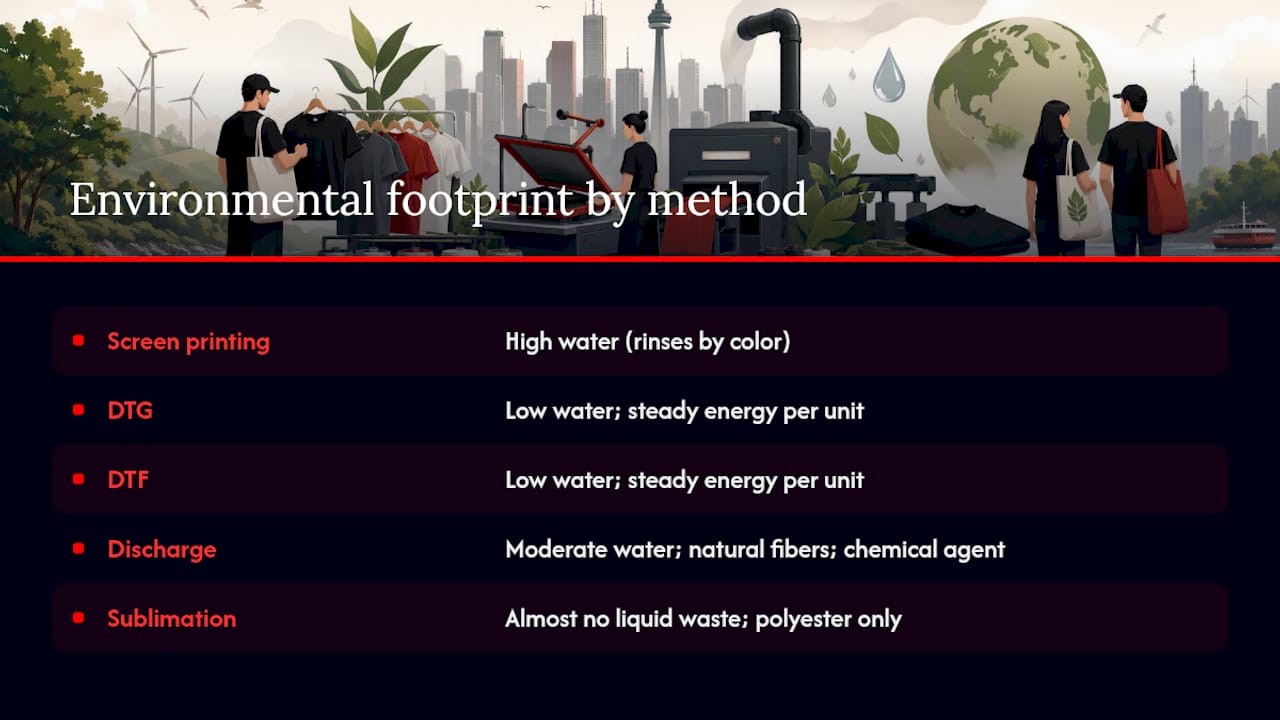
Screen printing, even the water-based kind, needs a setup process that rinses screens between color changes and between jobs. That rinse cycle is where most of the method’s water use happens, and it scales with the number of colors in a design rather than the number of shirts printed.
DTG and DTF use comparatively little water since the ink goes on directly with no screen rinsing involved, but DTG print heads and curing ovens draw steady electricity through every run, so energy cost per unit stays fairly constant no matter the order size.
Discharge printing sits in an odd middle ground: it uses a chemical agent to strip existing dye before applying new color, which lowers water use compared to some wet processes but only functions on natural fibers, and the discharge agent itself needs proper handling to avoid contaminating wastewater.
Sublimation generates almost no liquid waste since the dye transfers as a gas under heat, but it only works on polyester or poly-blends, tying its “clean” profile to a synthetic fiber that never biodegrades.
The honest takeaway: no single method wins across every metric. A screen print on organic cotton might use more water upfront than a DTG print on the same fabric, but the DTG shirt’s ink chemistry and the run size still matter more to total impact than the printing step alone.
What Happens to a Sustainable T-Shirt at the End of Its Life
A shirt’s sustainability story doesn’t end at checkout. What happens when it wears out matters just as much as what it’s made of.
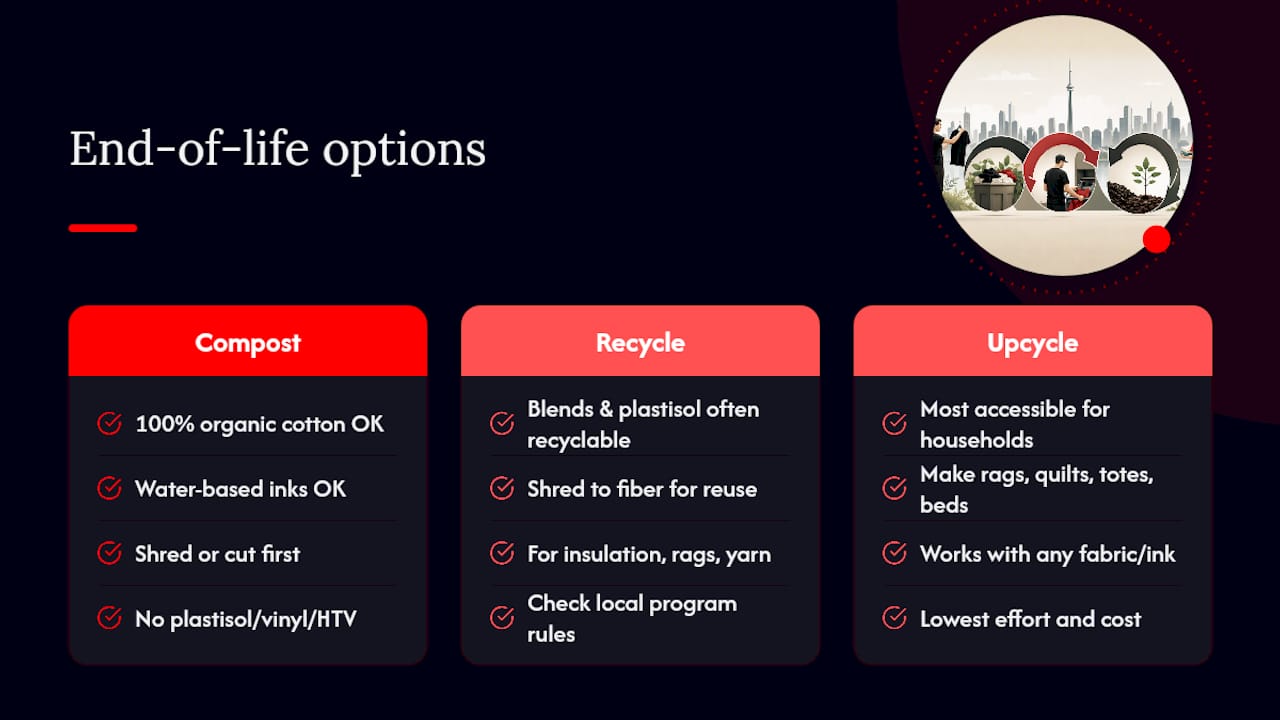
Garments printed on 100% organic cotton with water-based inks are compostable in principle, since neither the fiber nor the ink contains synthetic polymers that resist breakdown. In practice, home composting works best once the shirt is shredded or cut into smaller pieces, and it should never carry a plastisol or vinyl print, since those layers won’t break down and will contaminate the compost.
Blended fabrics and anything printed with HTV or plastisol generally aren’t compostable, but they can often still be recycled through textile recycling programs that shred fabric down into fiber for insulation, industrial rags, or new yarn blends. Check whether your municipality or a local textile recycler accepts printed garments, since some programs exclude anything with a plastic-based print layer.
Upcycling is the most accessible option for most households. A worn-out custom tee becomes a cleaning rag, a quilt square, a tote bag panel, or a pet bed liner with zero new resources consumed. It’s the lowest-effort, lowest-cost end-of-life choice, and it works regardless of fabric or ink type.
Garment longevity affects all of this. A shirt that lasts five years before wearing out has a smaller lifetime footprint than three shirts that each last a year, even if all three were technically “sustainable” on paper. Washing in cool water and air drying instead of tumble drying meaningfully slows fiber breakdown and keeps prints from cracking.
Brands Actually Getting Sustainable Printing Right
A handful of production models show what verified sustainability looks like in practice, rather than just in marketing copy.
Print-on-demand fulfillment paired with regional production hubs is one clear example. When orders print and ship from the facility closest to the customer instead of a single centralized warehouse, transport emissions drop simply because the shirt travels a shorter distance. That’s a structural fix, not a marketing claim, and it’s the same logic behind local pickup options.
On the ink side, some ink manufacturers have shifted toward formulations that source pigment from reclaimed industrial byproducts and plant-based dyes instead of virgin petroleum feedstocks, cutting the chemical footprint at the source rather than trying to offset it later. Facilities that pair those inks with renewable energy sourcing and FSC-certified or plastic-free packaging show what a full-chain approach looks like when a supplier commits to it rather than greenwashing a single step.
The pattern across all of these examples is the same: sustainability holds up when it’s built into the production model itself, not bolted on as a claim after the fact.
Where Buyers Get Sustainable Printing Wrong
The biggest mistake readers make isn’t choosing the wrong fabric or the wrong ink. It’s trusting a claim instead of asking for the number behind it. “Eco-friendly” and “sustainable” have no legal definition on a hang tag, which means the words cost a supplier nothing to print and cost you nothing to verify, if you actually ask.
Conventional advice tends to focus almost entirely on fabric choice, organic cotton this, recycled polyester that, while glossing over ink chemistry and production volume, which arguably matter more. A shirt made from certified organic cotton but printed through a high-waste bulk run with untreated plastisol runoff is not more sustainable than a well-made polyester shirt printed on-demand with certified water-based ink. Fiber content is one variable among three, not the whole equation.
If you take one thing from this: prioritize the paperwork over the pitch. Certificate numbers, safety data sheets, and a straight answer about wastewater handling tell you more in five minutes than an hour of reading a brand’s sustainability page. Garment longevity deserves more weight than it gets, too. A shirt you’ll wear for three years beats a “green” shirt that falls apart in six months, every time.
— Toronto
Order Sustainable Custom Tees Without the Guesswork
Torontocustomtshirts gives you a direct route to the sustainable choices this article just walked through, without hunting down a supplier willing to hand over certification numbers. Whether you need one shirt or a bulk team order, our DTF and DTG printing runs on-demand, so you’re never stuck overordering to hit a minimum, and we’re upfront about fabric and ink documentation when you ask for it.
If you’re weighing your options before committing, our guide on what to look for before ordering custom apparel covers the same verification questions in more detail, and readers researching general fair-sourcing verification practices may also find this ethical sourcing checklist a useful parallel framework, even outside apparel.
Ready to move forward? Request a quote through our Toronto printing services page and ask directly for fabric certification numbers and ink SDS documentation before you place your order. Or start browsing Torontocustomtshirts to see current blank garment and DTF options for your next run.
Sources
Recommended
Get pricing in 24h.
Toronto-based, no minimums. Tell us about your project and we'll email a detailed quote within one business day.
Request a Quote