No Inventory Spirit Wear Fundraisers in 2 to 3 Weeks for Organizers
Organizer focused guide to run spirit wear fundraisers in 2 to 3 weeks with no inventory, simple promos, and minimal volunteer work.
No Inventory Spirit Wear Fundraisers in 2 to 3 Weeks for Organizers
The best spirit wear fundraiser ideas share one trait: a limited-time online spirit store with a curated product mix, run over a strict 2 to 3 week window. Anchor it with a logo tee and hoodie, add two or three drop items tied to a school event, bundle for higher averages, and use a platform that handles payments and sorting for you. That combination raises the most money for the least volunteer time.
TL;DR:
- Running a 2 to 3 week online store with a limited product lineup and scheduled seasonal drops maximizes fundraising impact while minimizing volunteer workload.
- Core logo T-shirts and hoodies with full size range and prominent placement promote broad acceptance and higher margins, especially on hoodies.
- Employing a three-stage promotional plan—announcement, reminders with photos, and last-chance alerts—significantly boosts sales conversion.
- Setting clear prices based on all-in costs and targeted margins ensures profitability, with bundling increasing average order size without sacrificing margins.
- Using local printers with short turnaround times and no minimum orders simplifies fulfillment and minimizes logistical headaches.
Table of Contents
- What Are the Best Spirit Wear Fundraiser Ideas?
- How Do You Set Up a Spirit Wear Sale?
- How Should You Promote a Spirit Wear Sale?
- How Do You Price Spirit Wear for Maximum Profit?
- How Do You Handle Fulfillment Without Losing Your Mind?
- What Design Choices Actually Sell Spirit Wear?
- How Does a Local Printer Support Spirit Wear Organizers?
- What Organizers Get Wrong (and a Checklist to Fix It)
- How Toronto Custom T-Shirts Makes Your Spirit Sale Easier
- Sources
- FAQ
What Are the Best Spirit Wear Fundraiser Ideas?
Every idea below works because it does one of two things: it gets more people buying, or it gets each buyer spending more. The strongest fundraisers do both at once. Here’s the priority order, from highest impact to nice-to-have.
-
Core logo tee and hoodie line. This is your anchor. A clean one or two color logo on a mid-weight tee and a fleece hoodie covers the widest range of budgets and gives every buyer an easy “yes.” Stock youth small through adult 3XL, since sizing gaps are the number one reason parents skip the sale entirely. Hoodies typically carry better margin per unit than tees, so lead your promotional images with the hoodie even if the tee sells more units.
-
Seasonal and event drops. Instead of one static store that runs all year, treat your spirit shop like a small merchandising calendar. A back-to-school drop in late summer, a spirit week capsule in the fall, a game-day design before the big rivalry match, and a graduation collection in spring each create a fresh reason to buy. Retail-focused fundraising guides recommend tying drops to school calendar milestones rather than running one generic store, because a calendar-linked launch creates a natural buying window instead of an open-ended sale without urgency.
-
Bundles and upsells. Pair a tee with a beanie, or a hoodie with a drawstring bag, and price the bundle a few dollars below buying both separately. Bundling is one of the most reliable ways to lift average order value without cutting into your per-item margin, since the discount comes out of volume, not unit profit. A “spirit pack” of tee, lanyard, and sticker at a flat price often outsells the tee alone.
-
Audience-segmented items. A single all-purpose design leaves money on the table. Staff and coach polos, parent-friendly quarter-zips in muted colors, and senior-class keepsake shirts with a graduation year each speak to a specific buyer who wouldn’t wear the standard student design. Segmenting by audience consistently outperforms a one-size-fits-all approach, because a senior parent buying a keepsake shirt is shopping for something completely different than a ninth grader buying a hallway hoodie.
-
Accessory add-ons for impulse buys. Hats, beanies, drawstring bags, and lanyards are low-cost, low-risk items that round out a cart. They’re also the easiest thing to sell at a table or concession stand where someone wasn’t planning to spend $30 on a hoodie but will grab a $12 beanie on the way out.
-
Alternative sales channels beyond the online store. Pop-up tables at games, a concession-stand QR code linking straight to your store, and on-site sales at open house nights all catch buyers who never would have opened an email. A core product mix supported by event-specific items like drawstring bags and beanies, sold through these secondary touchpoints, catches impulse purchases the main promotional push misses entirely.
Pro Tip: Keep your total live catalog under 10 to 12 items. A store with 30 design options doesn’t sell more, it just makes every buyer take longer to decide, and slow decisions are the enemy of a 2 to 3 week sale window.
If you’re weighing garment styles for the core line, a full-zip hoodie style like the triblend lightweight full-zip hoodie gives you a premium option to sit above the standard pullover, while a youth midweight hooded sweatshirt keeps the family size range covered without adding a second vendor relationship.
How Do You Set Up a Spirit Wear Sale?
Your first real decision is print-on-demand online store versus bulk pre-order. An online store with no minimum order lets you launch fast, carry zero inventory risk, and let a vendor print each order as it comes in. A bulk pre-order means collecting orders and sizes up front, then placing one larger production run, usually at a better per-unit price, but with more manual counting and more risk if you guess sizes wrong. Guides on running these fundraisers consistently point to the online store model with a strict 2 to 3 week window as the safer default for volunteer-run groups, since it avoids the inventory headaches that sink first-time organizers.
Whichever route you pick, the setup steps are nearly identical:
- Get sign-off. Confirm the fundraiser with your school or organization’s leadership, including what percentage of proceeds go where.
- Lock the design. Finalize one to three designs before you build anything else; design delays are the most common launch killer.
- Choose your product mix. Pick your core items plus two or three drop or accessory add-ons, not more.
- Set your prices. Build in your target margin before you publish anything (more on the math below).
- Build the store link. Set up your online store or pre-order form and test the checkout yourself.
- Schedule your sale window. Pick a firm 2 to 3 week open and close date and put both on a calendar before you announce anything.
Choosing a system that automatically collects payment and organizes orders by size and buyer removes the single biggest source of volunteer burnout. Organizers consistently report that administrative overload, not lack of interest, is what kills repeat fundraisers, since chasing cash envelopes and hand-sorting spreadsheets eats far more time than the actual selling does.
How Should You Promote a Spirit Wear Sale?
Run your promotion as three deliberate pushes, not one announcement and a hope. Communication guides built around this exact model recommend an announcement 2 to 3 days before launch, active reminders through the sale, and a final last-chance notice right before the store closes, and that structure alone tends to lift conversion more than any single ad or flyer.
- Stage one, the announce. Send an email, a school app push, and a group text 2 to 3 days before the store opens. Say exactly what’s for sale and when it closes.
- Stage two, the reminder. Midway through your window, resend with a photo of someone actually wearing the gear, not just a flat product mockup.
- Stage three, the last chance. In the final 24 to 48 hours, be blunt: the store closes Friday at midnight, no late orders.
- Primary channels: email, school newsletter or app, and parent group texts reach the most buyers with the least effort.
- Supporting channels: social posts, a mascot or coach shoutout video, and a QR code taped up at the concession stand or front office catch everyone else.
Real photos convert better than clean product mockups, and being specific about where the money goes (new uniforms, a field trip, a scoreboard) outsells a vague “support our team” line every time. A countdown (“3 days left”) does real work here too. Scarcity isn’t a trick, it’s just honest, since your store actually is closing.
Pro Tip: Draft all three messages before launch day. Ready-made email templates built for group organizers can save you an hour of writing and keep your tone consistent across all three stages.
How Do You Price Spirit Wear for Maximum Profit?
Start with your all-in cost per item, meaning the blank garment, the print, and any platform fee, then add your margin on top of that number, not on top of the wholesale garment price alone.
- Basic tee formula: cost per item plus a target margin of roughly 35 to 45% gives you room to cover shipping surprises and still bank real profit.
- Hoodie formula: hoodies can typically support a slightly higher markup than tees, since buyers expect to pay more for a heavier garment and rarely comparison-shop a school fundraiser against retail.
- Bundle pricing: price a bundle a few dollars under the sum of its parts. You lose a little margin per unit but gain it back in higher average order value, since a $45 bundle beats two separate $22 sales that only half your buyers would have made anyway.
Here’s a conservative worked example. Say a tee costs $8 all-in to produce and you sell it at $18, that’s roughly a 55% margin, or $10 profit per shirt. A hoodie costing $16 all-in sold at $32 nets $16 profit per unit, again around a 50% margin. Sell 150 tees and 60 hoodies at those numbers and you’re looking at $1,500 from tees and $960 from hoodies before any bundle upsells, all from a single 2 to 3 week window.
How Do You Handle Fulfillment Without Losing Your Mind?
Your two real options are supplier-direct shipping to each buyer’s home, or one bulk shipment to a central pickup point like the school office.
- Direct-to-home shipping removes distribution work entirely from your volunteer team, but you’ll want to confirm tracking numbers and a clear exchange policy before you launch, since you won’t be the one handling size swaps.
- Central pickup usually costs less per unit but shifts real labor onto your volunteers. Distribution is the most underestimated workload in the entire fundraiser, even when the sale itself ran smoothly online.
- If you choose central pickup: print a manifest sorted by grade or last name, label bags before pickup day, and stage tables by grade level rather than making one long line.
- Volunteer-saver tips: a QR check-in code speeds up pickup, and naming one single point of contact for questions stops five volunteers from giving five different answers.
What Design Choices Actually Sell Spirit Wear?
Keep every design to two or three colors and one clear focal element, whether that’s a mascot, a crest, or a wordmark. Complicated designs look great on a screen and confuse buyers in person.
- Segment your designs: seniors want a keepsake with a graduation year, athletes want something game-ready, staff want something wearable to a normal workday, and parents want a design that doesn’t scream “kids’ merch.”
- Stock youth and adult sizes on every core item, and don’t skip extended sizes. A design a parent can’t fit into is a design that parent won’t buy.
- Hoodies and heavier fleece generally carry the best margin of any item in your lineup, so give them prominent placement in your store, not a scroll-down afterthought.
- Show the actual garment on an actual person whenever you can. A hoodie with a crest-style design photographed on someone wearing it will always outsell the same design shown flat on a table.
How Does a Local Printer Support Spirit Wear Organizers?
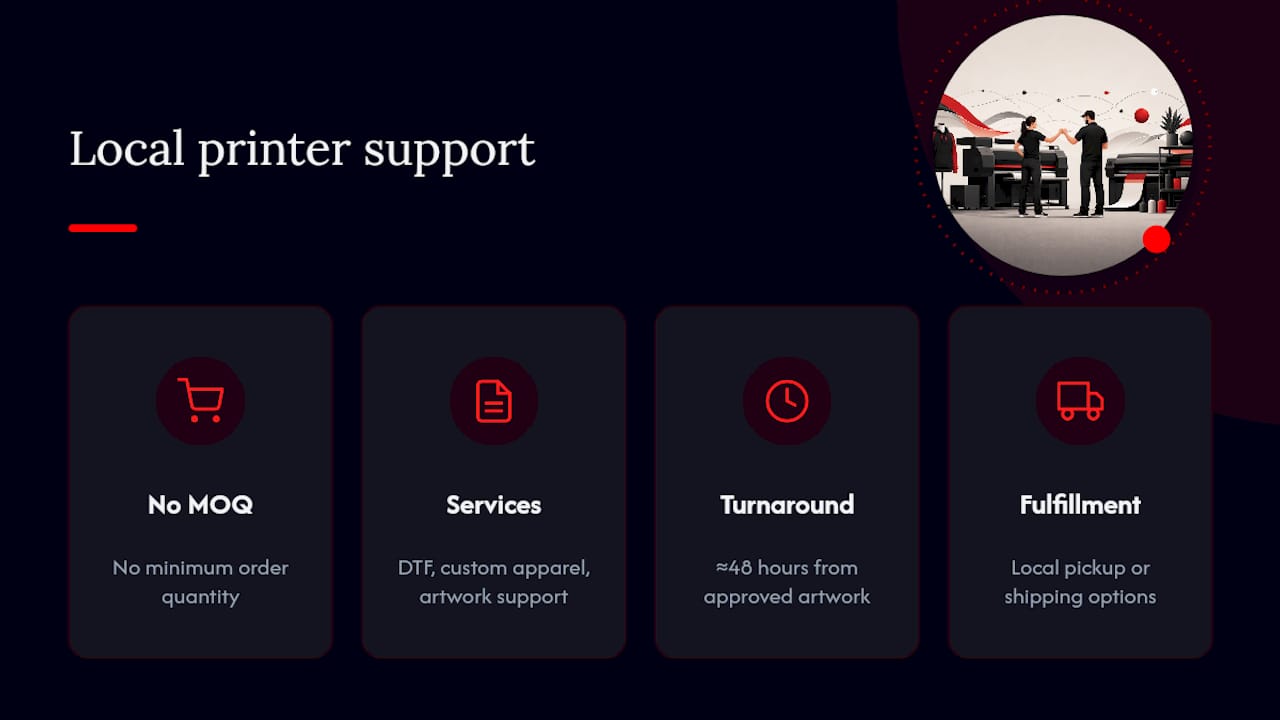
Running a spirit sale gets easier when your printer removes the guesswork on your end. A local printer can handle full-color DTF printing, custom apparel, and print-ready artwork support with no minimum order quantity, so a small senior-class drop and a school-wide hoodie sale can run through the same simple process. Turnaround can be about 48 hours from approved artwork to production, with local pickup or shipping options available. That timeline matters most in the final week of a 2 to 3 week sale window, when there’s no room left for a printing delay.
What Organizers Get Wrong (and a Checklist to Fix It)
The recurring failures are predictable: weak promotion (one email and silence), open-ended stores with no close date, guessing sizes instead of collecting them up front, and a distribution day nobody actually planned. Here’s the compact fix: lock approvals, set a firm 2 to 3 week timeline, finalize your product list and prices, schedule your three-stage promo plan, assign a distribution team, and send a thank-you the day after pickup. Save this checklist. You’ll reuse it for every drop.
— Toronto
How Toronto Custom T-Shirts Makes Your Spirit Sale Easier
Compared to piecing together separate vendors, a single provider can give organizers one point of contact for the whole job, with no minimum order and no middleman markup eating into your fundraiser’s margin. That matters most when you’re running a tight 2 to 3 week window and can’t afford a printer who needs two weeks just for proofs.
Whether you’re printing 20 senior keepsake shirts or 300 hoodies for a school-wide drop, our DTF printing options and bulk order pricing cover both small runs and full-school campaigns, with rush turnaround and free local pickup in Mississauga so your volunteer team isn’t stuck coordinating shipping logistics on top of everything else. If your group wants ready-made options to launch a quick drop without designing from scratch, our ready-made apparel collection is worth a look too. Request a quote today and tell us your sale window, and we’ll build the production timeline around it.
Sources
For deeper operational templates, see SignUpGenius’s spirit wear fundraising guide, RevTrak’s school spirit wear fundraiser breakdown, and CheddarUp’s free spirit wear fundraiser template.
- How to Sell Spirit Wear and Fundraising Apparel for Your Group — SignUpGenius
- How to Run Wildly Successful School Spirit Wear Fundraisers — RevTrak
FAQ
What Are the Current Trends in Spirit Wear?
Organizers are moving away from one static, all-year store toward limited seasonal drops tied to school events like spirit week, game day, and graduation. This calendar-based approach keeps the store feeling fresh and creates urgency instead of letting a sale sit open indefinitely with no real deadline.
What Is the Most Profitable Spirit Wear Fundraiser Idea?
A curated online store built around a core logo tee and hoodie, run over a strict 2 to 3 week window with a three-stage promotion plan, typically delivers the best return for the least volunteer labor. Adding bundles and accessory add-ons lifts the average order value without cutting into your per-item margin.
What Are Some Ideas for School Spirit Wear?
Strong options include a core logo tee and hoodie, staff and coach polos, senior keepsake shirts with a graduation year, and accessory add-ons like beanies and drawstring bags. Torontocustomtshirts can print any of these through DTF or custom apparel printing with no minimum order required, which makes small segmented runs realistic for volunteer teams.
What Are Some Good Outfit Ideas for a Fundraiser?
A logo tee paired with a matching beanie or drawstring bag makes an easy, affordable bundle that most buyers will say yes to. For a dressier event like a banquet or graduation, a quarter-zip or lightweight hoodie with a subtle crest design tends to outsell a loud, oversized graphic.
How Much Does It Cost to Print Spirit Wear Through Torontocustomtshirts?
Bulk custom t-shirts run $15 to $24.90 per shirt, while DTF gang sheet transfers start at $0.40 per transfer by size or from $40.80 per gang sheet when ordering by the roll. Add-ons like back prints or sleeve prints run $3 to $5 per print, letting you build a full product mix within your fundraiser’s price point.
Recommended
Get pricing in 24h.
Toronto-based, no minimums. Tell us about your project and we'll email a detailed quote within one business day.
Request a Quote