15–50% Rush Fees for T-Shirts: 5-Step Quote Checklist for Toronto
See how rush surcharges add 15–50% to t-shirt orders. Use a copyable 5 step quote checklist, get line item pricing, and save with Toronto local pickup.
15–50% Rush Fees for T-Shirts: 5-Step Quote Checklist for Toronto
Rush fees are a normal part of custom t-shirt printing, not a hidden penalty. Most shops charge somewhere between 15% and 50% above the base price depending on how fast you need the shirts, and you should expect that number to cover production speed only. Expedited shipping almost always gets billed separately on top of it. If a quote skips one of these two charges, ask why.
TL;DR:
- Rush order fees typically add between 15% and 50% to the base cost, with higher surcharges for same-day or extreme turnaround times.
- Larger rush orders generally cost more overall but may have a lower percentage increase, while small orders tend to have higher per-shirt costs due to setup limitations.
- The price of expedited shipping can range from $50 to $150 extra, and it is usually billed separately from the rush fee.
- Simplifying designs, choosing in-stock garments, and prioritizing urgent shipments can significantly reduce rush costs without missing deadlines.
- Clear, detailed quotes that break down production, rush, and shipping costs upfront help manage expectations and prevent unexpected charges.
Table of Contents
- What Counts as a Rush Order Fees T-Shirts Situation
- How Much Rush Fees Actually Add to Your Order
- What Actually Drives the Size of Your Rush Fee
- How to Get an Accurate Rush Quote in 5 Steps
- How to Cut Your Rush Fee Without Cutting Your Deadline
- Why This Pricing Breakdown Holds Up
- Our Take: Stop Treating Rush Fees Like a Trap
- Get a Rush Quote or Book Local Pickup
- Sources
- FAQ
What Counts as a Rush Order Fees T-Shirts Situation
A rush order means the shop has to break its normal production sequence to move your job to the front of the line. That sounds simple, but it touches nearly every step: art proofing gets compressed into hours instead of days, screens or DTF films get burned same-day, garments may need to be pulled from a rush supplier shipment instead of house stock, and curing and packing happen on overtime shifts rather than the regular schedule.
Shops generally sort urgency into a handful of tiers, and where you land determines both your fee and your options:
- Same-day: order placed and picked up within one business day, usually limited to smaller quantities and simpler designs
- 24-hour: next-business-day pickup or delivery, the most common rush tier for small businesses and events
- 48 to 72 hours: a moderate rush window that still lets the shop batch some production steps normally
- 3 to 5 days: the loosest rush tier, often barely more expensive than standard turnaround
Some suppliers publish these as named services like “Super Rush” versus “Rush” versus “Standard,” and the fastest tiers frequently limit garment and style choices to whatever is already sitting on the shelf. That’s not a bait-and-switch. It’s the only way a shop can promise a date without gambling on a supplier delivery.
How Much Rush Fees Actually Add to Your Order
Here’s the number that matters most: a 24-hour turnaround typically adds 25% to 50% on top of your base printing cost, and that’s before shipping. A looser rush window, say three to five days, usually sits closer to 15% to 25%. Same-day or “extreme rush” jobs can push past 50%, especially for small quantities where the shop’s setup time barely changes even though the order shrinks.
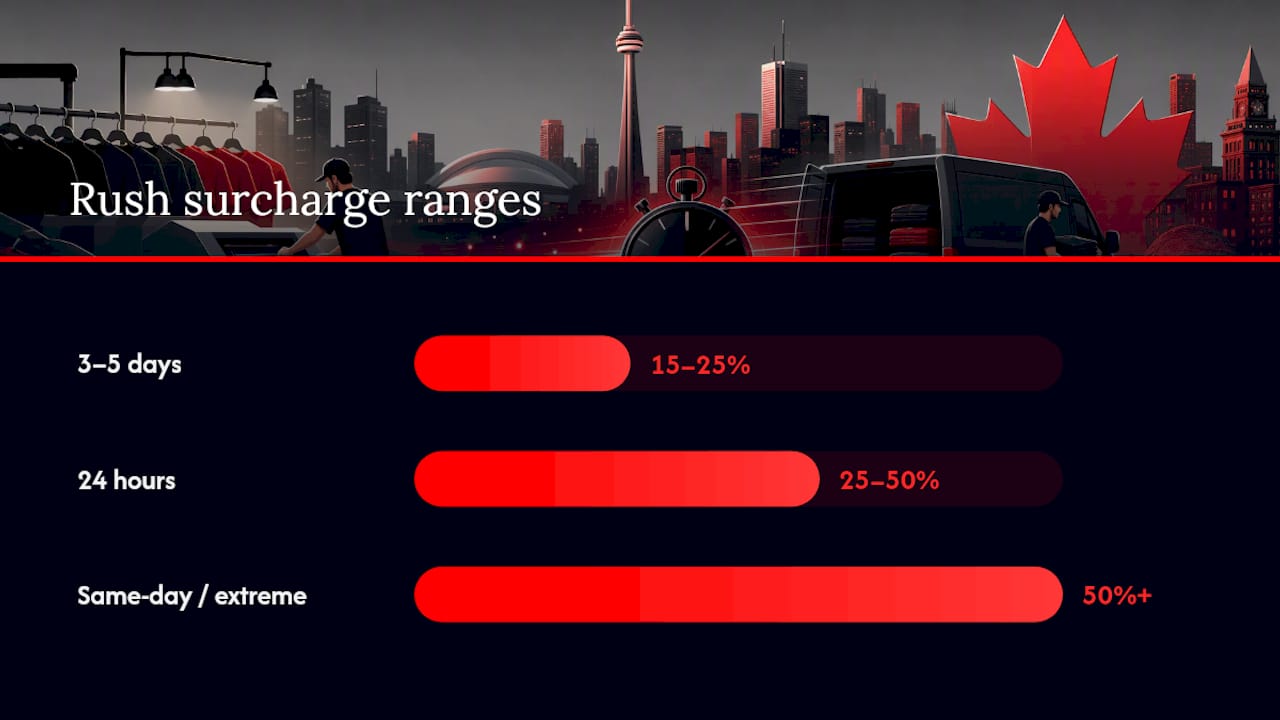
Quick reference: the rush surcharge typically lands between 15% and 50% of your base order cost, scaling with how compressed the timeline is.
Per-shirt costs vary a lot by method and quantity. Small runs printed with direct-to-garment (DTG) tend to run $20 to $35 per shirt once a rush fee is baked in, because DTG has almost no economy of scale. Screen printing flips that: setup costs get spread across more shirts, so larger rush runs can land closer to $8 to $25 per piece even with the surcharge applied.
Here’s how that plays out across three common order sizes:
Expedited shipping sits outside all of those figures. Overnight courier costs on a bulk box can easily add another $50 to $150 depending on weight and distance, so always ask for that as its own line item rather than assuming it’s folded into the percentage.
What Actually Drives the Size of Your Rush Fee
Not every rush job costs the same percentage, and the reasons come down to a handful of variables the shop is juggling behind the scenes.
- Order size: tiny orders cost more per shirt because setup time barely shrinks, while extremely large rush orders cost more in total because they strain staffing and press capacity at the same time.
- Printing method: screen printing needs separate screens per color, so a five-color rush design takes longer to set up than a one-color DTF transfer or DTG print.
- Garment sourcing: if your requested colors or sizes aren’t in house stock, the shop has to pay for expedited supplier shipments, and that cost gets passed through.
- Design complexity: multiple print locations (front, back, sleeve) and finishing touches like embroidery each add separate setup and production steps.
- Timing: missing a shop’s daily cutoff time, ordering over a weekend or holiday, or dragging out artwork approval all eat into the window the shop has to work with, and it makes up for that lost time with overtime labor.
Pro Tip: *Ask the shop what their daily order cutoff time is before you start designing.
Method choice is worth thinking through early. A DTF versus screen printing comparison can save you real money on a rush job, since one method might already have your design’s color count pre-separated and ready to press.
How to Get an Accurate Rush Quote in 5 Steps
A vague request gets a vague quote, and vague quotes are where rush jobs go wrong. Reputable suppliers will build you a line-item quote if you give them the right information up front, and they’ll also tell you honestly if a deadline isn’t realistic rather than accept the job and miss it.
- Finalize your artwork to print-ready specs first. Vector files or high-resolution PNGs with correct color values save the shop from having to fix your file on the clock, which is exactly the kind of delay that triggers extra charges.
- State your exact in-hands date, not just “as fast as possible.” Ask the shop to confirm which turnaround tier that date falls into and what their cutoff time is for that tier.
- Ask for the quote broken into three lines: base printing cost, rush surcharge, and expedited shipping. A shop that separates these clearly is one you can trust to bill accurately later.
- Ask about the proof and approval window. Find out what happens if you’re slow to approve a digital proof, and what the shop’s fallback is if they can’t hit your date, whether that’s a partial shipment or a garment substitution.
- Confirm pickup versus shipping and get the whole thing in writing. A confirmed pickup window with no courier involved often shaves real money off the total, and a written quote protects you if something changes mid-production.
Bringing a fully print-ready file to this conversation is the single biggest lever you control. Check a pre-order checklist before you request pricing so nothing gets kicked back for revision once the clock starts.
How to Cut Your Rush Fee Without Cutting Your Deadline
You can’t negotiate away every dollar of a rush surcharge, but you can control several inputs that shrink it.
- Simplify the design. Fewer colors and a single print location cut setup time dramatically, especially on screen printing where each color needs its own screen.
- Match the method to your quantity. DTG works fine for a rush order of a dozen shirts; screen printing usually wins on cost once you’re past 25 or so pieces, even under a rush timeline.
- Choose local pickup over overnight courier. Skipping the last-mile shipping charge is often the single biggest line item you can eliminate on a rush job.
- Split your order by priority. Rushing the sizes or recipients you need first and shipping the rest on standard timing usually costs less than accelerating every unit at once.
- Stick to in-stock garment colors and styles. Requesting an unusual color forces the shop into an expedited supplier order, and that cost lands on your invoice.
A partner catalog like Diet & Exercise’s ready-made shirt styles is a useful reference point for what “in-stock” typically looks like across the industry, since sticking close to common blanks is one of the easiest ways to dodge a sourcing surcharge.
Why This Pricing Breakdown Holds Up
Custom t-shirt printing shops print custom t-shirts, hoodies, sweaters, hats, uniforms, and DTF transfers for individuals, businesses, events, teams, and brands, which means these numbers reflect how orders actually move through a real production floor rather than a theoretical price sheet. Some shops run full-color DTF printing alongside traditional custom garment printing, and offer professional print-ready artwork support so a rush order doesn’t stall on a file that needs fixing.
Fast turnaround, clean print quality, and local pickup are operational pieces that keep a rush surcharge from spiraling. A shop built around speed, with inventory and staffing aligned to it, can hold a rush fee lower than one handling urgency as a one-off exception every time it comes up.
Our Take: Stop Treating Rush Fees Like a Trap
The conventional advice on rush fees tends to focus on finding the “cheapest” rush shop, and that’s the wrong first question. The bigger lever is almost always your file and your flexibility, not who you order from. A print-ready design with two colors and one location will cost less on a rush timeline at nearly any shop than a five-color, three-location design will cost at the most competitively priced one.
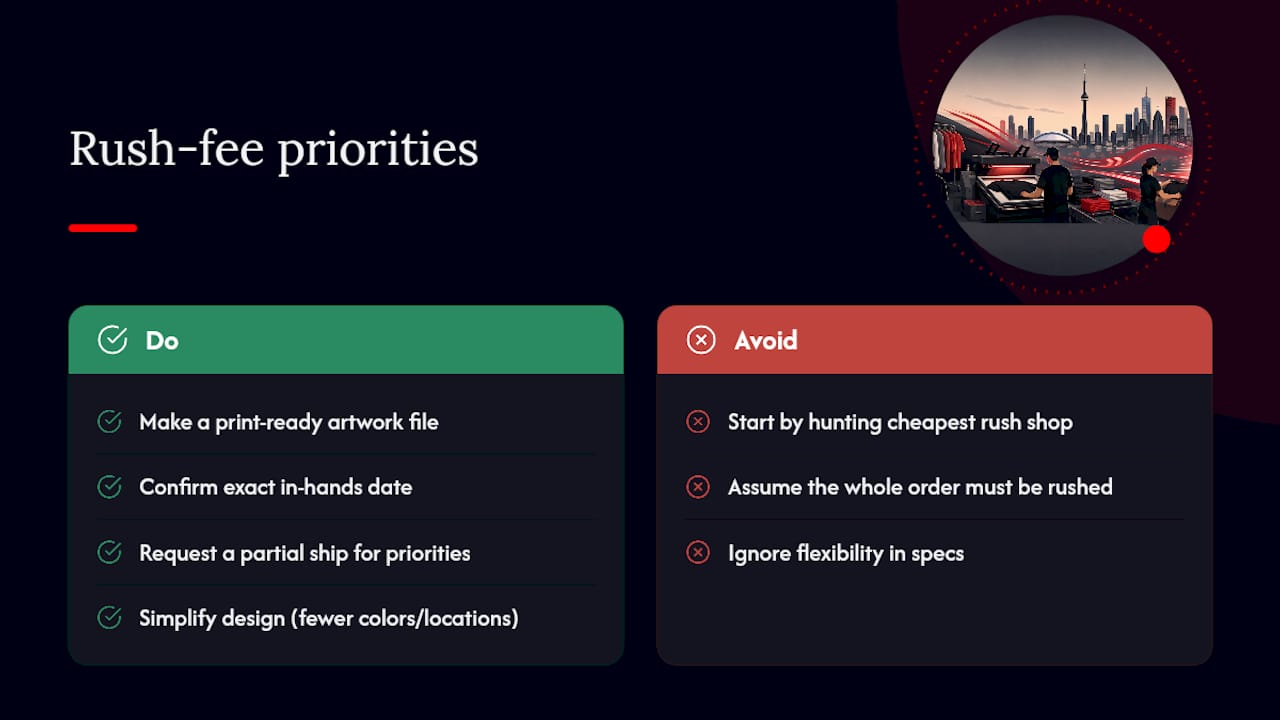
What’s genuinely underrated is asking for a partial ship. Most buyers assume rushing an order means rushing all of it, but prioritizing the ten shirts you need for tomorrow’s event and letting the rest arrive on standard timing routinely cuts the bill more than any amount of shopping around.
If you take one thing from this, prioritize your artwork and your in-hands date accuracy before you request a single quote. Everything else, the percentage, the per-shirt cost, the tier you land in, follows from those two decisions.
— Toronto
Get a Rush Quote or Book Local Pickup
Torontocustomtshirts runs rush production with pre-aligned garment stock and print-ready artwork support built in, so you’re not paying an ad-hoc premium every time a deadline moves up. That means fewer surprise line items and a faster path from file to finished shirt than piecing together design help and rush shipping separately.
To get a rush quote, send your final artwork, your exact in-hands date, sizes, and quantities. If you’re in Mississauga, Toronto, or across the GTA, local pickup is available and it skips the expedited courier charge entirely. Larger team or corporate orders that still need fast turnaround can also request bulk pricing with rush options directly. Start your quote request on the Toronto custom apparel page and get a line-item breakdown before you commit to a date.
Sources
- Rush Order Tees: Your guide to fast, high-quality custom shirts
- Rush Order Tees Pricing: How Much Should You Expect?
- Rush and expedited orders — Merch Resources
FAQ
What is a rush order for t-shirts?
A rush order is a t-shirt printing job the shop moves ahead of its normal production queue to meet a tighter deadline, usually involving faster art approval, expedited garment sourcing, and overtime production.
Is rush order tees legitimate?
Rush order t-shirt services are a standard, legitimate part of the printing industry, though quality and reliability vary by supplier, so always confirm turnaround tiers and get a written line-item quote before paying.
Does rush shipping apply on top of the rush production fee?
Yes. The rush production surcharge covers moving your job ahead in the queue, while expedited shipping to get the finished shirts to you fast is billed as a separate cost.
How can I lower my rush order cost without missing my deadline?
Simplify your design to fewer colors and one print location, choose local pickup over courier shipping, and prioritize a partial shipment of your most urgent sizes or recipients first.
Recommended
Get pricing in 24h.
Toronto-based, no minimums. Tell us about your project and we'll email a detailed quote within one business day.
Request a Quote