DTF Durability for Toronto: Benchmarks and Quality Control
Learn what a '50 washes' lab score means for DTF prints, which process errors can cut life to 10–15 washes, and how Toronto sample runs verify real...
DTF Durability for Toronto: Benchmarks and Quality Control
Properly produced and applied DTF prints typically survive many home washes—commonly around 50 or more—matching or beating vinyl and rivaling screen printing in real-world wear. The catch: that range only holds when curing, pressing, and peel timing are done right. Most early failures are generally linked to production shortcuts rather than inherent limitations of the DTF process itself.
TL;DR:
- Proper curing, peel timing, and finishing press are essential for DTF prints to reach 50 to 100 wash cycles before noticeable fading or edge wear.
- Material choices such as ink formulation, TPU powder quality, and film release significantly influence the durability and flexibility of the final print.
- Consistent equipment calibration and process control, especially temperature, pressure, and peel method, are critical for maximizing wash resistance and preventing early failure.
- Common causes of early failure include insufficient press pressure, thick white bases, improper peel techniques, and moisture trapped during post-press curing.
- Working with an experienced local printer who follows strict quality control steps significantly reduces the risk of print cracking, fading, or edge lifting.
Table of Contents
- How Long Do DTF Prints Last? Industry Benchmarks Explained
- What Affects DTF Durability: Materials, Equipment, and Process
- Why DTF Prints Fail Early: Root Causes and a Prevention Checklist
- DTF vs. Vinyl, DTG, and Screen Printing: Durability Compared
- Washing, Drying, and Ironing: Care Instructions That Extend Print Life
- Why Working With an Experienced Local Printer Reduces Early Failures
- The Real Bottleneck in DTF Durability Isn’t the Technology
- Get Production-Tested DTF Prints With a Sample Run First
- Sources
How Long Do DTF Prints Last? Industry Benchmarks Explained
When suppliers say a DTF transfer will “last 50 washes,” they’re usually referencing a specific lab protocol: AATCC TM61-2A, the industry standard for colorfastness to laundering. This test simulates repeated washing and then scores the result on a grey-scale grading system, where 5 means no visible change and 1 means severe fading or damage.
Quality DTF prints commonly land at a grey-scale grade of 4 to 4.5 after cycles equivalent to roughly 50 home washes. Visually, that grade means a trained eye can detect slight color shift under close inspection, but a customer wearing the shirt would notice nothing unusual. That’s a strong result, and it’s the number most manufacturer claims are built on.
The AATCC Benchmark, Translated: A grade of 4 to 4.5 after 50 wash-equivalent cycles doesn’t mean the print looks brand new. It means the color loss is barely perceptible to the naked eye, which is the threshold the apparel industry treats as “durable” for everyday wear.
The realistic range is wider than any single number suggests. Best-case scenarios, meaning correct curing, proper peel timing, and a finishing press, routinely stretch to 80 or even 100 washes before edges soften or color noticeably dulls. Poor application can cut that lifespan to a fraction of the benchmark, sometimes failing within 10 to 15 washes.
The gap between those two outcomes isn’t random. It comes down to a handful of controllable variables in the production chain, and Martindale abrasion references and stretch-cycle data show the same pattern: process control, not the printing technology itself, is what separates a shirt that holds up for two years from one that cracks after a month.
What Affects DTF Durability: Materials, Equipment, and Process
DTF printing longevity depends on a chain of decisions made long before a customer ever runs a wash cycle. Break it down and it falls into three categories: materials, equipment, and the pressing process itself.
Materials matter more than most buyers realize. Ink formulation affects how flexible the cured film stays after repeated stretching. The white underbase, printed first to make colors pop on dark garments, needs to be thick enough for opacity but not so thick that it turns brittle. TPU hot-melt powder grade determines how well the ink bonds to fabric, and cheap powder is one of the most common reasons prints fail early. Film release quality affects whether the transfer separates cleanly during peeling, which sounds minor but has an outsized effect on edge durability.
Printer reliability is the quiet variable nobody talks about. A printhead with clogged or misfiring nozzles lays down ink unevenly, creating thin spots that wear through fast. Shops running consistent maintenance schedules produce noticeably more uniform results than those pushing printers past service intervals.
Here’s what actually determines whether a print survives the wash-test benchmark or falls apart early:
- Powder application evenness: automated shaker systems distribute TPU powder far more consistently than manual shaking, directly affecting bond strength across the design.
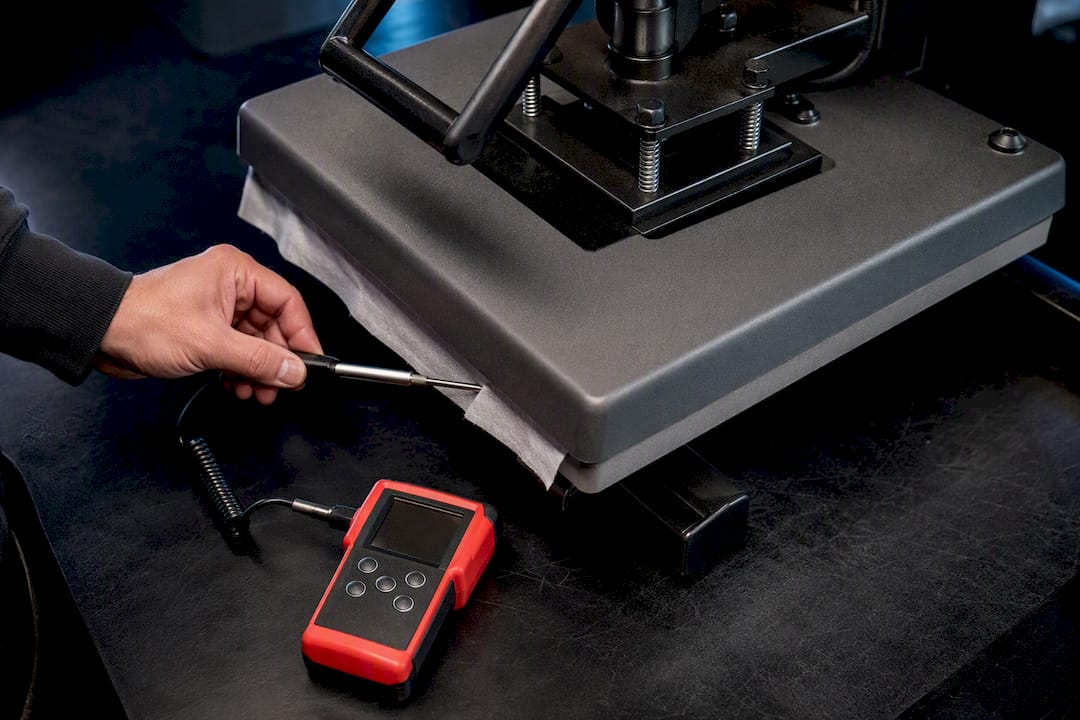
- Press temperature: curing typically falls between 150°C and 170°C for short dwell times, and drifting even 5 to 10°C outside that window can undercure or scorch the film.
- Press time and pressure: too little time or pressure leaves adhesive incompletely bonded; too much can push ink through the film or flatten texture.
- Peel method: cold peel versus hot peel isn’t a style choice, it’s a chemistry match to the specific film, and using the wrong method for the wrong film is a leading cause of edge lifting.
- Finishing press: a second press after peeling, confirmed by multiple vendor sources as a durability driver, locks adhesive into the fabric weave and measurably improves wash resistance.
Fabric choice plays its own role. Cotton and cotton blends generally hold DTF transfers well because the weave gives the adhesive something to grip. Polyester requires more attention to temperature since it’s more heat-sensitive and prone to dye migration under high heat, and pure synthetic performance fabrics sometimes need a lower-temperature transfer film to avoid scorching.
Pro Tip: A 5 to 10°C swing on your heat press might not sound like much, but it’s often the exact difference between a print that survives 80 washes and one that cracks by wash 20. If your press doesn’t have a reliable digital readout, get one calibrated. It’s the cheapest insurance in the entire production chain.
Why DTF Prints Fail Early: Root Causes and a Prevention Checklist
Most DTF failures show up as one of four visible problems, and each one points to a specific process mistake.
Edge lifting happens when the corners or perimeter of a design start peeling away from the fabric after a few washes. This almost always traces back to insufficient press pressure, a skipped finishing press, or peeling the film before the adhesive has fully set.
Cracking shows up as fine lines or a crackled texture across the printed surface, usually in the white underbase. This is a strong sign the white layer was printed too thick, making the cured film brittle instead of flexible enough to move with the fabric.
Fading appears as gradual color loss, often faster on reds and darker tones. Undercuring is the usual culprit. If the press never reaches full temperature for the required dwell time, the ink never fully bonds to the film.
White-base breakdown, a grayish or yellowing cast developing under the color layer, points to moisture trapped in the garment or film during pressing, which interferes with adhesive bonding.
A repeatable QC workflow catches these problems before a shirt ever leaves the shop:
- Pre-press the garment for a few seconds to drive out moisture and wrinkles before applying the transfer.
- Run a test swatch on scrap fabric matching the customer’s blank whenever switching film batches or powder lots.
- Calibrate press settings to a documented temperature, time, and pressure for that specific film and fabric combination.
- Follow the correct peel procedure, matching cold or hot peel to the film manufacturer’s spec exactly.
- Apply a finishing press after peeling to lock adhesive into the fabric.
- Respect post-press cure time before folding, packing, or shipping, since handling a still-warm print can shift the adhesive before it fully sets.
Pro Tip: Most shops treat the finishing press as optional. Treat it as mandatory. It’s the single cheapest step in the entire workflow, adding maybe 10 seconds per shirt, and skipping it is one of the most common reasons transfers fail the wash test early.
DTF vs. Vinyl, DTG, and Screen Printing: Durability Compared
Each decoration method fails in its own characteristic way, and knowing the failure pattern helps you pick the right one for the job.
- Heat transfer vinyl tends to fail at the edges first, especially on designs with fine detail or lots of small cut pieces, since each edge is a potential lift point.
- DTG (direct-to-garment) generally holds its shape well but fades gradually with repeated washing, since the ink sits in the fibers rather than forming a separate film layer.
- Screen printing remains the most abrasion-resistant option for large, simple designs, but it can’t match DTF or DTG on full-color complexity or small-batch economics.
- DTF, done correctly, avoids the edge-lifting problem that plagues vinyl on complex designs and holds color better than DTG over time, while offering more stretch and a softer hand feel than thick plastisol screen ink.
DTF makes the most sense for full-color designs, small production runs, and garments that need to stretch, think athletic wear or fitted tees, where a softer feel matters. Screen printing still wins for high-volume runs of simple one- or two-color logos headed for heavy commercial laundering or extreme abrasion environments, like uniforms washed daily at a fleet laundry. If you’re deciding between DTF and screen printing for a specific order, the tradeoff usually comes down to expected wash frequency, stretch needs, and how much color complexity the design actually requires, a comparison worth reviewing in more depth before committing to bulk production.
Washing, Drying, and Ironing: Care Instructions That Extend Print Life
Even a perfectly produced DTF print won’t reach its full lifespan if it’s cared for poorly. The good news is the rules are simple and apply to nearly any printed garment.
- Wait 24 hours after pressing before the first wash, giving the adhesive time to fully cure and bond to the fabric.
- Wash inside out on a gentle cycle at 30 to 40°C to reduce friction against the printed surface.
- Skip bleach and fabric softener, both of which break down the adhesive layer faster than plain detergent.
- Air-dry when possible; if using a dryer, keep it on low heat, since high dryer heat is one of the fastest ways to shorten print life.
- Avoid direct sunlight when line-drying, since UV exposure accelerates color fading.
- Never iron directly on the print. Turn the garment inside out or use a cover sheet, and keep the iron on low heat if ironing is unavoidable.
Treat stains quickly but gently, and stick to spot treatment rather than soaking. The fewer aggressive wash cycles a printed shirt goes through, the closer it gets to that 80 to 100 wash upper range instead of the lower end of the benchmark.
Why Working With an Experienced Local Printer Reduces Early Failures
Most of the failure modes covered above are process errors, not limitations of DTF as a technology. That’s exactly why supplier choice matters as much as the printing method itself.
Torontocustomtshirts runs full-color DTF transfers with calibrated press settings, test swatches before production runs, and finishing-press application on every job, the same steps outlined in the QC checklist above. Local pickup across Mississauga, Toronto, and the GTA means samples can be checked in person rather than guessed at from photos.
Before committing to a supplier for a bulk order, ask these questions:
- Can they run a sample wash test on your specific fabric blank?
- What curing temperature and dwell time do they use, and is it documented?
- What grade of TPU powder do they apply, and is it automated or manual?
- Do they apply a finishing press as standard practice or only on request?
Suppliers who answer these clearly are the ones whose prints will actually hit the durability numbers they advertise, a detail worth confirming before placing a bulk order that needs to look sharp for months, not weeks.
The Real Bottleneck in DTF Durability Isn’t the Technology
The conventional wisdom treats DTF like it’s inherently less durable than screen printing or vinyl. That’s backwards. The chemistry behind modern DTF film and TPU adhesive is capable of matching those older methods on wash resistance. What actually separates a print that lasts two years from one that cracks in a month is almost entirely process discipline: cure temperature held steady, peel timing respected, a finishing press applied without exception.
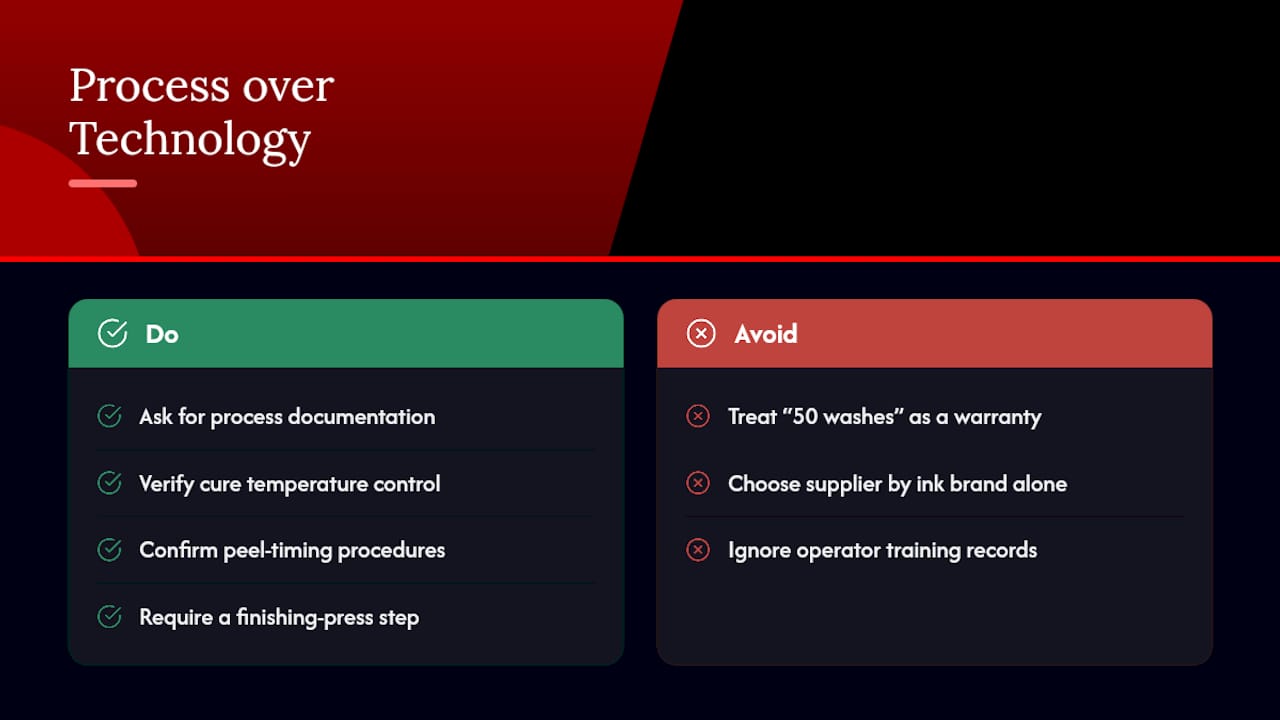
Where most buyer advice falls short is treating “50 washes” as a fixed spec, like a warranty number. It’s a benchmark from a specific lab test, not a promise. Real-world results swing wildly based on who’s running the press and how carefully.
If you’re evaluating a supplier, stop asking “is DTF durable?” and start asking “what’s your process?” The answer to that second question tells you far more than any brand claim about ink formulation ever will.
— Toronto
Get Production-Tested DTF Prints With a Sample Run First
Torontocustomtshirts applies the same finishing-press workflow and calibrated settings covered throughout this piece on every full-color DTF order, so you’re not guessing whether your prints will hold up.
Rather than taking a durability claim on faith, request a test swatch or sample run before committing to a full order, whether that’s a handful of shirts for a small business or a bulk run for a team. Local pickup is available across Mississauga and the greater Toronto area, and bulk orders come with volume discounts once you’re ready to scale past a sample. Start with a quote for your Toronto or GTA order, or check bulk pricing for team and corporate apparel if you’re printing in volume from the start.
Sources
- Why Print Durability Matters in Direct-to-film Printing | Roland DG
- DTF print durability explained: washing, stretching and wear – AIPrinter
Recommended
Get pricing in 24h.
Toronto-based, no minimums. Tell us about your project and we'll email a detailed quote within one business day.
Request a Quote