$0.40 DTF Option: Cotton vs. Polyester for Printing, Toronto Tips
Method first guide for makers and small print shops. Choose cotton or polyester by printing method, with Toronto tips and DTF at $0.40.
$0.40 DTF Option: Cotton vs. Polyester for Printing, Toronto Tips
When a garment mixes fibers or you’re printing a small run, DTF or heat transfer vinyl sidesteps the fabric problem entirely. Blends split the difference and usually cost you something in either vibrancy or hand feel.
TL;DR:
- Cotton with 80 to 100 percent content offers the best absorption, saturation, and fine detail for water-based ink methods like DTG and screen printing.
- Polyester is ideal for sublimation because its molecular structure allows dyes to chemically bond inside the fiber, providing color that is washfast and feels invisible.
- Blends, especially 50/50, are poor choices for ink-based or sublimation printing because they either hinder ink absorption or limit color vibrancy and durability.
- DTF transfers work on almost any fabric, making them ideal for small runs, mixed fibers, and quick turnaround projects without pretreatment concerns.
- The best fabric choice depends on the intended printing method, not personal preference, and selecting the wrong combination can lead to faded, flat, or dye-migration issues.
Table of Contents
- Cotton vs. Polyester for Printing: The Fiber Chemistry Behind the Rule
- Screen Printing and DTG: Why Cotton Still Wins
- Sublimation Printing: Why Polyester Is Non-Negotiable
- DTF and HTV: The Flexible Middle Ground
- What Common Blends Actually Do to Your Print
- Care, Wash Life, and What to Tell Your Customers
- A Quick Checklist for Choosing Fabric and Method
- Shop Notes From Toronto Custom T-Shirts
- Why the “Best Fabric” Question Is Really the Wrong One
- Order Your Next Print Run With Toronto Custom T-Shirts
- Sources
- FAQ
Cotton vs. Polyester for Printing: The Fiber Chemistry Behind the Rule
The reason one fabric outperforms another for a given method comes down to what the fiber is made of, not marketing. Cotton is cellulose, a plant fiber riddled with microscopic pores that soak up water like a sponge. That’s exactly what water-based inks need. Cotton’s cellulose structure absorbs water-based inks well, which is why it became the default substrate for direct-to-garment printing and most screen printing.
Polyester is a different animal. It’s a synthetic polymer, PET, essentially the same plastic used in soda bottles, and it has almost no absorbency at all. Water-based ink beads up on it instead of soaking in. To print on polyester, you need disperse dyes, which turn to gas under heat and lodge inside the fiber itself rather than sitting on the surface.
A few terms worth knowing before you brief a print shop:
- Dye migration: dye trapped in polyester fibers bleeding into the ink layer over time, usually from heat or humidity.
- Pretreatment: a liquid applied to cotton before DTG printing so water-based ink bonds instead of soaking through unevenly.
- Underbase: a white ink layer printed first on dark garments so colors on top stay true.
- Hand feel: how the printed area feels against skin. Absorbed ink stays soft; surface-bonded ink can feel stiffer.
Absorption gives cotton its soft hand and rich saturation. Chemical bonding gives polyester its durability but locks out plain water-based ink altogether.
Screen Printing and DTG: Why Cotton Still Wins
Water-based DTG ink needs a fiber that drinks it in, and nothing drinks better than ring-spun or combed cotton, which has fewer loose fibers to blur fine lines and small text. Plastisol screen printing behaves a little differently since it’s a thick, opaque ink that cures on the surface rather than soaking in, but cotton still gives it the cleanest, most predictable release from the screen.
Polyester content works against both methods. It resists water-based ink outright, and it introduces a nastier problem for screen printers: heat-curing plastisol on poly-blend garments can trigger dye migration, where the fabric’s own dye bleeds up through white or light-colored ink and leaves a pink or yellow stain days later.
For anyone specifying a blank garment for either method, here’s the practical breakdown: See the CottonLux men’s polo t-shirt for an example cotton blank useful in ink-based printing.
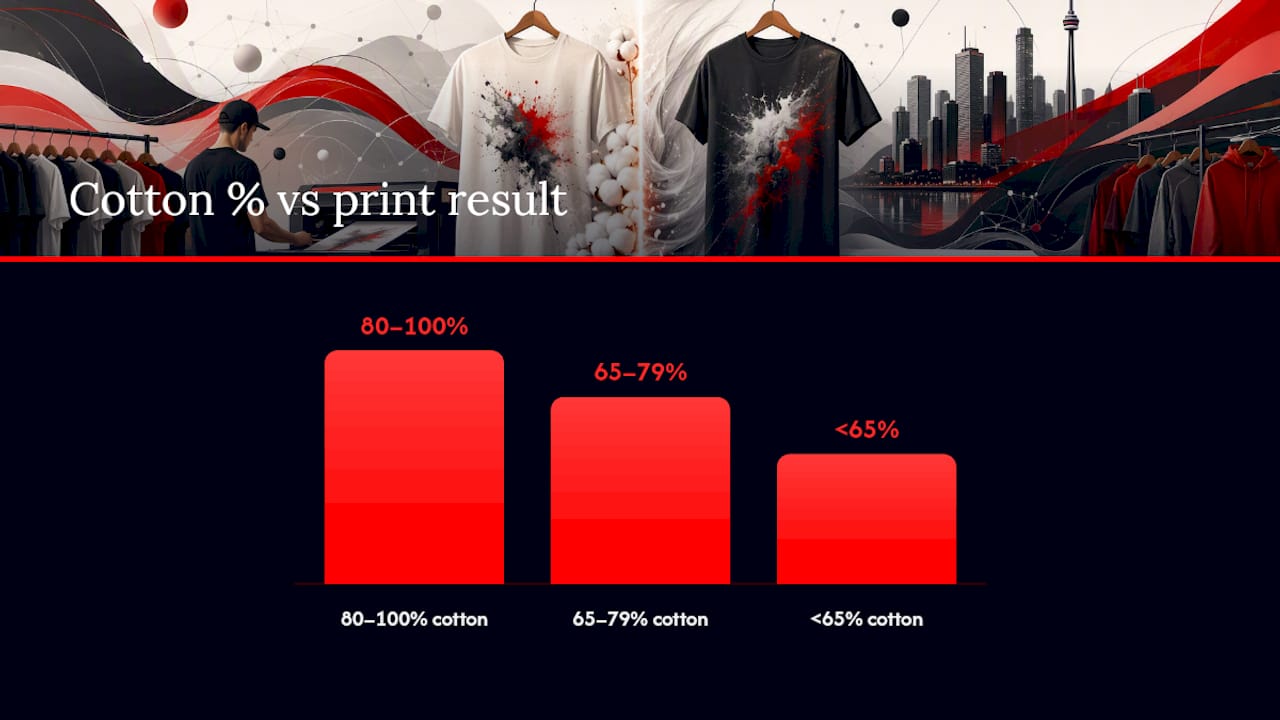
- 80 to 100% cotton gives the best detail, saturation, and softest hand. This is the safe default for logos, photo prints, and fine text.
- 65 to 79% cotton still runs reliably through most DTG printers but expect slightly muted colors.
- Below 65% cotton is a gamble. Ink sits on the surface instead of soaking in, and colors look washed out.
Pro Tip: If you’re not sure what a blank is made of, run one test shirt through the full wash cycle before committing to a bulk order. A garment that looks fine fresh off the press can reveal dye migration or cracking after just one hot wash.
Sublimation Printing: Why Polyester Is Non-Negotiable
Sublimation works because polyester’s molecular structure has open space for gas to enter and solidify inside. The dye turns into a gas under heat and pressure and bonds chemically with polyester fibers, rather than sitting on top of the fabric the way plastisol or DTG ink does. Try it on cotton and the gas has nothing to grab onto. The color simply doesn’t take.
At full polyester content, the dye becomes part of the fiber itself, which is where sublimation’s biggest advantages show up:
- No hand feel at all. You can’t feel the print because there is no print layer sitting on the surface.
- Exceptional washfastness. The color fades at roughly the same rate the fabric itself does.
- All-over prints and photo-quality gradients that other methods can’t replicate at the same cost per unit.
The catch is real, too. Sublimation has no white ink, so it can’t print light colors or detail onto a dark garment; the shirt has to start light or white. And because it needs high polyester content to look good, sublimation is a poor fit for anyone who wants a soft, cotton-feel product for retail apparel.
DTF and HTV: The Flexible Middle Ground
DTF (direct-to-film) transfers print onto a special film first, then heat-press the design onto almost any fabric, cotton, polyester, blends, even nylon, without worrying about absorption or dye chemistry at all. That flexibility makes it the go-to for small runs, mixed-fiber team orders, or photo-quality designs where fabric composition is unpredictable or the run is too small to justify a screen setup.
Heat transfer vinyl (HTV) works well for logos, numbers, and small solid-color designs, and it’s durable enough for athletic wear, but it sits on top of the fabric as a distinct layer, which means more hand feel than DTF or DTG.
A few practical notes for either method:
- DTF typically presses at around 300°F with firm pressure for 10 to 15 seconds, then a cold peel.
- HTV heat settings vary by vinyl type; always check the specific product’s temperature chart before running a full order.
- Always test-peel one transfer before running a full batch, especially on garments you haven’t printed on before.
- Polyester and poly-blends need lower heat than cotton to avoid scorching or glossing the fabric surface.
What Common Blends Actually Do to Your Print
Every blend is a trade-off, and the ratio tells you almost everything about what to expect.
Higher-cotton blends fare better.
Tri-blends and heathered fabrics add another wrinkle, literally, at the surface level:
- Tri-blends (cotton, polyester, and rayon) create a slightly uneven surface that gives prints a soft, vintage look rather than a flat, sharp one.
- Heathers contain flecks of a second color woven through the fabric, which can show through lighter ink as a faint speckle.
- Designs with large solid-color fields show these texture effects more than busy, multicolor artwork does.
Care, Wash Life, and What to Tell Your Customers
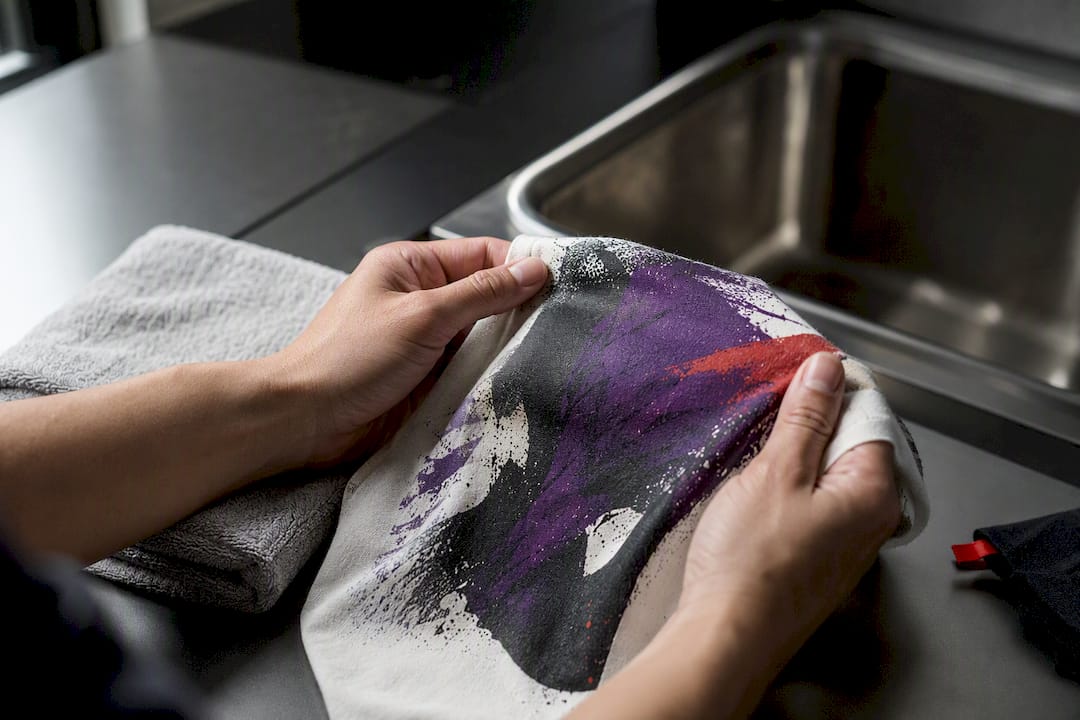
Print durability depends as much on how a garment is cared for as on how it was printed. Well-cured plastisol on cotton and DTG on properly pretreated cotton both hold up through dozens of home washes when cared for correctly, and sublimation prints last essentially as long as the polyester garment itself since the dye is part of the fiber. DTF and HTV sit in between; expect real durability, but a shorter lifespan than sublimation if the shirt goes through the dryer on high heat repeatedly.
A few habits extend any print’s life:
- Wash inside out in cold or warm water, never hot.
- Skip the dryer when possible; air-dry or use low heat.
- Avoid fabric softener and bleach, both of which break down ink and dye over time.
- Never iron directly on a printed area.
Sustainability enters the conversation here too. Cotton is biodegradable, but the energy spent on hot washes, tumble drying, and ironing over a garment’s life can offset that advantage compared with easy-care polyester, which often needs less aggressive laundering to look new. Neither fabric wins outright on environmental impact; it depends on how the wearer treats it after the sale.
A simple care label goes a long way toward preventing complaints: “Wash cold, inside out. Do not iron design. Tumble dry low or air dry.”
A Quick Checklist for Choosing Fabric and Method
Start with the end use, not the fabric. A retail graphic tee calls for a different setup than a marathon jersey or a one-off event shirt, and matching the method to the job upfront saves reprints later.
- Retail or fashion tees: 100% or high-cotton blend with DTG or screen printing for the softest hand and richest detail.
- Athletic or performance wear: 100% polyester with sublimation for moisture-wicking performance and colors that never crack or fade.
- Team merch or event giveaways on a budget: cotton-poly blends with DTF transfers, since DTF doesn’t care about fiber content and keeps per-unit costs predictable.
- Small runs or one-off orders: DTF or HTV over screen printing, since screen setup costs only pay off at higher volumes.
Cost and quality scale together here. Screen printing gets cheaper per unit as order size grows, which makes it the right call for 50-plus identical shirts, while DTF holds a flat per-piece cost that suits smaller or mixed-size orders better.
Pro Tip: Never run a full order on a fabric or method you haven’t tested. Order one sample shirt, put it through a wash cycle, and check the print before committing to fifty or five hundred units.
Shop Notes From Toronto Custom T-Shirts
Working across DTF gang sheets, custom DTF prints, screen printing, and rush turnaround jobs day to day surfaces a pattern fast: most reprint requests trace back to a fabric-method mismatch, not a design flaw. For a single shirt or a small run, we lean on DTF because it handles cotton, poly, and blends without any pretreatment guesswork. For team uniforms and bulk orders where everyone needs a matching, durable print, we look at the fabric composition first and build the recommendation around it rather than defaulting to one method for every order. With local pickup available and turnaround built around 48 hours, most customers can order today and know exactly what they’re getting before it ships.
Why the “Best Fabric” Question Is Really the Wrong One
The most common mistake buyers make is asking which fabric is better in the abstract, cotton or polyester, as if one wins across the board. It doesn’t work that way. The fiber chemistry settles the question the moment you know your printing method: water-based ink needs cotton’s absorbency, sublimation needs polyester’s chemical structure, and no amount of preference changes that.
Where conventional advice falls short is treating blends as a safe middle path. A 50/50 shirt isn’t a compromise that satisfies both methods equally; it’s a fabric that does DTG worse than cotton and sublimation worse than polyester, chosen mainly for cost and availability rather than print quality. If durability and vibrancy matter more than unit price, a blend is often the wrong call dressed up as a safe one.
The fix is simple, if unglamorous: decide the printing method first, then let that decision choose the fabric. Buyers who reverse that order, picking a fabric they like and hoping the print method adapts, are the ones who end up back at the print shop asking why their colors look flat or their whites turned pink.
— Toronto
Order Your Next Print Run With Toronto Custom T-Shirts
Once you know whether your project calls for cotton, polyester, or a blend, the next question is who prints it well and fast. Torontocustomtshirts runs DTF gang sheet printing starting at $0.40 per transfer or $40.80 per gang sheet, which sidesteps the whole cotton-versus-polyester debate since DTF adheres to nearly any fabric without pretreatment.
For teams and events, bulk DTF-printed custom T-shirts run $15.00 to $24.90 per shirt with no minimum order quantity, and add-ons like back prints or sleeve prints start at $3 to $5 per print. Single-shirt orders get the same live design preview and 48-hour turnaround as bulk runs, with free local pickup in Mississauga so you’re not paying agency markups or waiting on a middleman. Upload your artwork, choose your fabric and print method based on what this guide just walked through, and get a quote before you commit to a single unit.
Sources
- Direct-to-garment printing — Wikipedia
- DTG printing: which fabrics and products get the best results? - Xinflying
- Why cotton is better than polyester — Cotton Gins
FAQ
Is 80% Cotton, 20% Polyester Good for Printing?
Yes, a high-cotton blend close to 80% cotton is close to ideal for DTG and screen printing since the high cotton content still absorbs water-based ink well.
Is 100% Cotton or 100% Polyester Better for Printing?
Neither is universally better; it depends entirely on the printing method. Choose 100% cotton for DTG and screen printing, and choose 100% polyester when sublimation is the method, since sublimation dye only bonds chemically with polyester.
Why Are Some Buyers Moving Away From Polyester?
Some buyers prefer cotton for its softer hand feel and biodegradability, but polyester’s easy-care properties and long service life can offset its synthetic footprint over the garment’s lifespan. The right choice still comes down to how the garment will be printed and worn, not fiber preference alone.
Is 50% Cotton and 50% Polyester Good for Printing?
A 50/50 blend works as a budget-friendly compromise, but it’s not ideal for either DTG or sublimation. Screen printing on 50/50 blends needs low-bleed inks to prevent dye migration, and DTF or HTV transfers often perform more reliably on this blend than ink-based methods do.
Which Printing Method Works Best for Small or Single-Shirt Orders?
DTF transfers are usually the best fit for single shirts or small runs because they print on nearly any fabric without pretreatment or fabric-specific setup. Torontocustomtshirts offers DTF gang sheet printing starting at $0.40 per transfer, with no minimum order quantity required.
Recommended
Get pricing in 24h.
Toronto-based, no minimums. Tell us about your project and we'll email a detailed quote within one business day.
Request a Quote